Al Watch

Al Trautwig’s back! The Outdoor Life Network launched its Tour de France coverage Saturday, and they’ve got the same gallery of syntax- and image-torturing rogues breathlessly covering every breathless mile. The ring leader: the mellifluous-voiced Trautwig, who has wasted no time unloading fresh gems from his 2005 Tour simile/metaphor/cliche trove. To wit:

During Saturday’s prologue: “It’s the tip of the needle in the haystack.”

During Sunday’s stage on Thor Hushovd, Norway’s favorite cycling son: “His body’s as wide as the country he represents. …” Of course Norway is a very long, very skinny country.

July 2, 1863

An account of one incident on Gettysburg’s second day from Shelby Foote, who died earlier this week (Slate published this analysis of his complex place in Civil War lore and historiography on Friday):

“[Union General Winfield Scott Hancock] ordered Gibbon and Hays to double-time southward along the ridge and use what was left of their commands to plug the gap the rebels were about to strike.

“He hurried in that direction, ahead of his troops, and arrived in time to witness the final rout of Humphreys, whose men were in full flight by now, with Wilcox close on their heels and driving hard for the scantily defended ridge beyond. As he himself climbed back up the slope on horseback, under heavy fire from the attackers, Hancock wondered how he was going to stop or even delay them long enough for a substantial line of defense to be formed on the high ground. Gibbon and Hays ‘had been ordered up and were coming on the run,’ he later explained, ‘but I saw that in some way five minutes must be gained or we were lost.’ Just then the lead regiment of Gibbon’s first brigade came over the crest in a column of fours, and Hancock saw a chance to gain those five minutes, though at a cruel price.

” ‘What regiment is this?’ he asked the officer at the head of the column moving toward him down the slope.

” ‘First Minnesota,’ Colonel William Colvill replied.

“Hancock nodded. ‘Colonel, do you see those colors?’ As he spoke he pointed at the Alabama flag in the front rank of the charging rebels. Colvill said he did. ‘Then take them,’ Hancock told him.

“Quickly, though scarcely a man among them could have failed to see what was being asked of him, the Minnesotans deployed on the slope … 262 men present for duty … and charging headlong down it, bayonets fixed, struck the center of the long gray line. … The Confederates recoiled briefly, then came on again, yelling fiercely as they concentrated their fire on this one undersized blue regiment. The result was devastating. Colvill and all but three of his officers were killed or wounded, together with 215 of his men. A captain brought the 47 survivors back up the ridge, less than one fifth as many as had charged down it. They had not taken the Alabama flag, but had held onto their own. And they had given Hancock his five minutes, plus five more for good measure.”

July 1, 2005

Iraq, 835th Day:

“… It is indeed better to fight here. If Iraq has become a training ground for terrorism, so be it. It is then fortunate that the best military in the world just happens to be here ready to locate, close with, and destroy them before they spread. Here in Iraq we are a target for terrorism. Good! They know where to find us, and we invite them to do so. We are wining this fight. One shot at a time. One block at a time, one pair of shoes on a child’s feet at a time, one vote at a time, one free election at a time. To a soldier this is simply duty, nothing more. To the Iraqis, this is a gift, paid with the blood of youth, paid for in missed anniversaries, paid for in bitter combat, paid for in the hopes and dreams of Americans being forever extinguished on streets called, Haifa, and 60th, in towns called Dora, and Karadda. In a country called Iraq, in a place once called the cradle of civilization. We are the light by which the new democracy of Iraq will traverse through the darkness. We are Americans!”

From a U.S. soldier’s blog: Si Vis Pacem, Para Bellum

July 1, 1863

Gettysburg, First Day:

“… Wadsworth’s division was falling back…, the rebs pushing rapidly on and cheering. They were also attacking the Eleventh Corps at the same time. The Cashtown Road being our most important point, each one had aimed to take care of it. Robinson had ordered Stewart (Battery B, 4th US) to take post on each side of the railroad. Doubleday had ordered Stevens (Battery E, 5th Maine Artillery) from where I had placed him at the left to the road itself. Cooper (Battery B, 1st Pennsylvania) had his four guns immediately in front of the main building… Thus there eighteen pieces on a frontage of not over two hundred yards. But there was no time to make changes, for the rebs were coming steadily on down the ridge in front only five hundred yards off and all the guns were blazing away at them as lively as possible. In a little time I went to the right and front of (Lieutenant) Wilbur’s section, one piece of which was on the Cashtown Road. I found Lieutenant Davison had thrown his half of Battery ‘B’ around so as to get an oblique, almost enfilading fire on the rebel lines. His round shot, together with the canister poured in from all other guns, was cutting great gaps in the front line of the enemy. But still they came on, the gaps being closed by regiments from the second line, and this again filled up a third column which was coming over the hill. Never have I seen such a charge. Not a man seemed to falter. Lee may well be proud of his infantry; I wish ours was equal up to it.”

–From “A Diary of Battle, The Personal Journals of Colonel Charles S. Wainwright, 1861-1865

Det Var En Gång En Cykel

Cykel

Swedish, I think, for "there once was a bicycle." Someone was sending this around on a bike club email list. It’s a sedate little Flash slideshow of the quiet life of a Swedish bicycle abandoned on a picturesque canal bridge. If I could read Swedish, I could tell you more: The movie is being served from the site of Dagens Nyheter, Sweden’s largest-circulation daily, which last week ran a story on the bike and the people who made the movie. Oh, the movie: It’s here.

The Irrigator

Idly perusing job listings at California newspapers — don’t draw any inferences from that activity — I came across an ad from the Patterson Irrigator. I don’t remember what position they’re trying to fill — checking the paper’s site online, it looks like a pretty good little rag — but the name attracted me. The Irrigator. It fits Patterson, which is on the western edge of the San Joaquin Valley, a little south of Altamont Pass; it’s a farm town, and there’s in California that means irrigation’s a big deal.

Made me think of other favorite newspaper names:

–The (Bloomington, Illinois) Pantagraph (until tonight I puzzled over the origin of the name, knowing only that one meaning of pantagraph (or pantograph) is an accordion-like metal device on the top of a train car that transmits power from overhead electrical lines (or alternately,a metal frame used for reproduction in drafting. But neither of these have anything to do with the newspaper’s name, which is explained here.

–The New Orleans Times-Picayune

–The Daily Breeze in Southern California.

–The Laramie Boomerang.

–The Berkeley Daily Planet. A hometown entry, just for the Perry White conceit.

–The Warren Sheaf. Back into farm country; a weekly from Marshall County, Minnesota, my dad’s birthplace.

OK. That’s a baker’s half-dozen in all. Enough for tonight.

Spam Poem

I got a great email the other day from Brandi Talbot. The name alone says she wants to make me big or rich (or both) or hook me up with potent but dirt cheap pharmaceuticals or give me loads of no-interest credit. I never opened her message, but her subject line was pure randomly generated art:

“Of sing on punic whir.”

I can almost hear those words coming out of Lawrence Ferlinghetti’s mouth:

“I dreamt I dreamed

Hannibal in the Alps without elephants

Blood running Roman down Tiber and plain

The empire bled white centurions dismounted

Of sing on punic whir.”

Well, maybe not Ferlinghetti. Someone.

Flying Home

Thunderheads_1

Airline travel has become endlessly irritating and uncomfortable most of the time. The snack boxes they used to give away as consolation that those bad hot meals weren’t served anymore? Now you have to pay five bucks for one, and various combinations of chips, jerky, whizzed cheese, pretzels and cookies have been given cute names like QuickPick, JumpStart, Biafra, and Moe. But now I’m wandering.
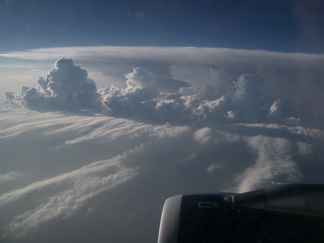
I always take a window seat if one’s available. I can deal with the confinement as long as I have a chance to look out the window. I’ve always found the view of the world outside and below full of a beauty so singular and surprising I don’t feel fit to express it. So, Monday evening on United Flight 863 from O’Hare to San Francisco: Somewhere over Iowa we flew past this wall of storm clouds growing into the summer sky to the north. Even though I was pretty sure a picture would only hint at the play of light and texture and shadow, I pulled out my little digital camera and took a couple of shots. Glad I did.

Gone Cycling, and Back

I flew to Chicago over the weekend to ride in a 600-kilometer (375-mile) event I needed to qualify for next month’s Gold Rush Randonee here in California. The ride actually started in Wisconsin, from the little town of Delavan (a little northeast of Rockford, Illinois) and wandered around several of the state’s southern and central counties.

Beautiful riding, but cutting to the chase: I didn’t manage to finish. The first half of the ride went just fine, I was on pace to finish the first 400k in about 20 hours, get a couple of hours of sleep, and head back out to finish before the heat of the following day. I really had no doubts I would make it. Just at that point, though, a big storm hit and I got held up for several hours at a gas station in a little town called New Glarus. The ride never got back on track for me after that, though I had a memorable ride through a rainy night across some hilly and seemingly deserted back roads. After finishing the 400, I felt completely used up and wound up quitting the ride. There’s a little more to it than that, and I’ll write more later, because most of the part I did was exceptionally fun and challenging and the country beautiful. But that’s the bottom line.