Spite ‘n’ Schadenfreude

A couple years ago I told my colleague (and San Francisco Giants fan) Endo that a perfect day for me as a baseball fan would go like this: A’s win, Cubs win, Giants lose. Yeah, that’s the bitterly unhappy level to which my rooting interest in baseball has fallen: I take what passes for glee when a team loses (for now at least I won’t go into the twisted psychohistory behind my dark feelings for the San Francisco nine).

Given my leanings, this week has been special: The A’s started it on an epic roll. The aspiring-to-mediocrity Cubs entertained the mediocrity-would-be-an-improvement Giants for three games at the cute little loser’s paradise at Clark and Addison. The results for the first part of the week: Ecstasy. Agony. Ecstasy again. (Translation: On Monday, the A’s won and the Cubs beat the Giants — which is actually a little spite bonus on my definition of perfection; on Tuesday, the results were reversed; on Wednesday, they swung back the other way).

Now the Giants have left Chicago, and their losses will bring only a normal helping of sour satisfaction (though the way the Giants’ division is going, they could win it if they can get back to .500). The Cubs — well, they’ll dance around the .500 mark for the rest of the season and pack the house all the way to the end; neither wins nor losses will surprise or disappoint much; only three years till the centennial of their last World Series championship — it would be a shame to wipe out that streak before it hits 100. And the A’s: Hey, they’re actually fun to follow, especially after their horrible start this year, and anything they can do from here on in will be both pleasing and surprising.
‘The Victim and the Killer’

What I think is a great piece of reporting from Salon.com’s correspondent in Baghdad: The story (subscription required) of how a U.S. Army sniper killed Yasser Salihee, an Iraqi doctor working as a journalist for the Knight-Ridder News Service. Salon’s reporter, Phillip Robertson, had gotten to know Salihee and his family and decided to find the soldier who killed his friend and find out his version of what happened. Since our military maintains a strict and nearly complete silence about the civilian casualties it has inflicted in Iraq, and since it couldn’t be expected to cooperate with a journalistic investigation into Salihee’s death, Robertson took it upon himself to see if he could find the American unit involved and get embedded with it. He did it, and eventually met the unit’s sniper, identified only as “Joe,” who showed him pictures he had stored on a laptop of his tour of duty in Iraq.

“Then he brought up a photograph of a white Daewoo Espero sedan on a Baghdad street. The sedan had a single bullet hole in the driver’s side of the windshield. Behind the wheel there was a lifeless man, slumped in the seat with a shattered skull and a torrent of blood staining his shirt. The image carried a sudden shock of recognition and despair. The dead man behind the wheel of the car was my friend and colleague, Yasser Salihee.

“The sniper lowered his voice when he talked about the pictures of the car and the man inside it. His self-assured manner disappeared and he became nervous. ‘Here is one of ours. I really hope he was a bad guy. Do you know anything about him?’ Then he said, ‘See, I don’t know if I should be talking about this.’

” ‘Did you fire the shot that killed him?’ I asked.

” ‘I don’t know.’

“Joe said that it was true that he fired the shot through the Espero’s windshield, but he wasn’t positive if it was the lethal shot. There was no doubt that it was, but Joe seemed to be genuinely uncertain about it. It was clear that he did not want it to be true.”

I didn’t hear about it or read about it when Salihee was killed. After reading Robertson’s piece, I went looking and found a couple of tributes to him from colleagues: One from the Knight Ridder bureau chief in Baghdad, another from an NPR reporter for whom Salihee served as translator.

An awful irony: Reading about Salihee, he is just the kind of person one might hope could flourish in a land rid of dictatorship and fear, by all accounts a dazzlingly intelligent, giving, brave and daring soul. Yet his life was consumed by what we’ve set loose in Iraq. Among his wife’s comments, a few weeks after the shooting: “I want the Americans to go back to America, but I know they won’t go.”

A Cyclist, 1884

“In appearance, he was anything but a holiday wheelman. Brown as a nut, and mud-bespattered, all surplus fat had been worn off by his severe and protracted work. His blue flannel shirt was a deal too large for him and much weather-stained. His knickerbockers had given way to a pair of blue overalls, gathered at the knees within a pair of duck hunting leggings, once brown, but now completely disguised as to texture and color by heavy alkali mud.”

Description of Thomas Stevens in Cheyenne, Wyoming, during his transcontinental bicycle “ride” (he pushed his cycle nearly as much as he pedaled it) in 1884. I wanted to read about Stevens because his trip began in Oakland. An account of his journey appears in an 1887 book called “Ten Thousand Miles on a Bicycle,” by Karl Kron; Kate got me a facsimile reprint a few years ago.

Naturally, I did a little search for more information on Stevens. The very first Google listing brings up an account from Harper’s Weekly with an illustration of someone considerably less weather-beaten than the character described above. Kron’s account mentions that Stevens took his bicycle across the Atlantic the following spring and set out across Europe and western Asia, getting as far as Tehran, Iran, before winter weather stopped him. The Wikipedia account discloses the next chapter (and what happened to Stevens’s bike much, much later): He made it to Japan and sailed back to San Francisco in 1886, the first person, apparently, to have cycled around the world.

And finally, Stevens’s own story of his journey is online, thanks to Project Gutenberg. Here’s how the ride starts:

“With the hearty well-wishing of a small group of Oakland and ‘Frisco

cyclers who have come, out of curiosity, to see the start, I mount and

ride away to the east, down San Pablo Avenue, toward the village of the

same Spanish name, some sixteen miles distant. The first seven miles are

a sort of half-macadamized road, and I bowl briskly along.

“The past winter has been the rainiest since 1857, and the continuous

pelting rains had not beaten down upon the last half of this imperfect

macadam in vain; for it has left it a surface of wave-like undulations,

from out of which the frequent bowlder protrudes its unwelcome head, as

if ambitiously striving to soar above its lowly surroundings. But this

one don’t mind, and I am perfectly willing to put up with the bowlders

for the sake of the undulations. The sensation of riding a small boat

over “the gently-heaving waves of the murmuring sea” is, I think, one

of the pleasures of life; and the next thing to it is riding a bicycle

over the last three miles of the San Pablo Avenue macadam as I found it

on that April morning. …”

What the People Want …

… Is video of Joe Theisman getting his leg broken on “Monday Night Football.”

In April, I wrote something about Al Lucas, the Arena Football player killed during a game. Later, someone posted a comment asking if anyone knew where to find some Web video of the gruesome Theisman incident from 1985. Somehow, I’ve never seen the sequence, but it involves the former Redskins quarterback getting hit by New York Giants linebacker Lawrence Taylor. Theisman’s leg bends in a way that nature never intended until the lower part snaps. All this was apparently obvious on live TV, and the sequence was replayed many times, at least at the time it happened.

It’s an immortal sports TV moment. Bloggers are still fascinated by it (including one who makes it one of the top 10 most unpleasant things that’s ever happened, along with events like the 9/11 attacks and the Challenger disaster). Every day, several people arrive on this site via Google in search of the Theisman video.

The surprise is that, as far as I can tell — which means, as far as my Google and other search skills go — that video just ain’t online (although I haven’t checked any of the P2P file-sharing services like Kazaa or BitTorrent — they might be the most likely sources). So an idea for ABC Sports: A 20th anniversary DVD of the Theisman moment. They could put the entire game on one disk. They could put Theisman’s leg on another disk, complete with player and fan commentary and maybe an expert explanation with X-rays and such from the orthopedic surgeons who put the leg back together. Maybe they could add a compilation of the 25 most brutal plays in”MNF” history. The package could be promo’d on “Monday Night Football,” which needs something to keep the audiences interested. Every week, the show could do a countdown of the plays. And they could do an audience poll for most memorable mayhem moments.

Hey, I’m just saying there’s a market.

The Wistfulness of Victory

Lance Armstrong just did what everyone who followed the Tour de France this year saw he would do: He won for the seventh time in a row. Now the race is over and he’s going into retirement. Which makes me feel lost on a couple of counts.

First: No more Tour. For the last three weeks — as for the past several years during Tour time — we’ve gotten up every morning and stumbled straight to the TV to turn on OLN’s live race coverage. I know I’ve whined about the incumbent announcers (it’s only a matter of time before someone gives Phil Liggett the Phil Rizzutto treatment and turns transcripts of his play-by-play into a book of “poetry. No, wait: Someone already has), but the anticipation of the unknown drama to unfold in the next morning’s stage has been wonderful. Would we wake up to a big breakaway? To Lance finally collapsing under relentless attack or having the Tour-ending mishap he always managed to avoid? (No way.) With the tube on, I’d fire up my laptop and keep track of the time gaps from the official Tour site. Every day: a coffee-powered multimedia frenzy. Now, it’ll back to the sports page and box scores when I get up (hey, the serious stuff can wait till I’m really awake).

Second: No more Lance. Paddling free of the hype-and-glitz whirlpool for a second — the cancer miracle, the celebrity girlfriend and all the rest — as an athlete the guy is really in a class by himself not just in cycling but in all sports. It’s astounding: his ability to plan and train the way he has all this time, and the combination of strength, guts and genius to perform when the moment demands it and resist the daily efforts of scores of people who have dedicated themselves to beating you. That has been thrilling to watch year in and year out; and — I probably have lots of company — I’m just a little sad to see it come to an end.

A Short Nighttime Spin

I’ve got 21.4 miles on my little cycle computer from a ride I did last night. Drove up to Davis to see if I could catch my friend Bruce returning from his 750-mile trek up to the Oregon borderlands and back. I started out from Davis toward a little town called Knight’s Landing about a quarter to 11, a little spooked about riding by myself on a Friday night. But I was fine as soon as I really got rolling, absorbed in taking in the warmth of the night — out in the Valley so much like I remember from Illinois — the moon rise, and watching the little circle of pavement my bike light illuminated. I had no idea how far I’d go before I met Bruce. He’d left the rest stop at Oroville, 88 miles up the road, a little before 6 p.m. Ordinarily, someone of his abilities would make that trip — mostly flat with no wind to speak of — in about a little less than five hours. But with the 670 miles in your legs, and with the heat of the last few days to take the starch out of you, I was figuring the trip would take seven hours, even eight.

A few miles out I encountered a single rider. I didn’t think it was Bruce — the lights were different — but I thought I’d see how the guy was He turned out to be Larry from upstate New York, and he started asking me about the turns he’d have to take on the way to the finish. I wound up riding all the way back in with him to show him.

I rode out again. Saw several riders pass in twos threes and fours. None looked to be Bruce, and I just cheered them on and kept riding. About the same place I encountered the first solo rider I met another. I asked if he needed any help. He said no, he knew just where he was and he’d be fine. About 30 seconds later he said, “I wish I knew where I was.” So I rode up to the next turn with him, too, before turning around once more.

Heading north again, I saw the lights of Woodland ahead; and also those of a couple bikes. They passed, I did my U-turn, and caught up. “I heard that there was really some really hard-core bike ride going on out here,” I said to the trailing rider. He confirmed that and added that he had the sore ass to prove it. Then the leading rider said, “Hey, is that Dan?” It turned out to be Bruce, really tired and really glad to hear that when I said I’d been riding for an hour and a half it did not mean we were an hour and a half from the finish. In fact, we were at the final control in about 10 minutes. Easy ride for me. Awesome one for him and everyone else who did it.

The Boalt Tour: Part IV

Law schools and business schools attract very bright people, many or perhaps most of whom have their eyes on careers that will pay handsomely. To compete for new generations of very bright people, professional schools need continual investment in the faculty and facilities that make them attractive places of study. To invest, the schools need constant infusions of cash. For a publicly supported professional school like Boalt Hall. most of the cash comes from the state’s taxpayers, student fees, and private donors. Not suprisingly, the biggest group of donors are alumni, the past generations of very bright students who have gone on to their brilliant and rewarding careers. Once the alums have coughed up their money — and the schools remind them often that it would be greatly appreciated if they could scan their forgotten T-bill accounts for a few thousand stray bucks to help out the alma mater — the school has a way of giving back: Hanging the donor’s name in a place of honor. The more decimal places on the check, the grander the placement.

At Boalt, the former law dorm cafeteria (now a cafe) is named for Melvin Belli, a fabulously successful San Francisco ambulance chaser of the old breed and old century; the registrar’s office bears the name of Larry Sonsini, perhaps the most successful and best-known technology lawyer in Silicon Valley. The names are everywhere. A dogleg lobby between the law library and the registrar has two names — one for each section of the passageway. One section of Boalt’s main courtyard memorializes a family that produced a half-dozen Boalt grads between 1930 and 1970 (and lots of gifts, too).

Even individual offices have donor nameplates — though I’m not sure whether it’s the office or the fancy modern brushed aluminum address sign (with coordinating mini-corkboard) the donors’ gift paid for. I was curious about the name attached to my shared office, number 205. Howard B. Crittenden Jr. was a pre-Web man and left only a modest store of Google-able facts — just four hits, in fact. They’re all lawsuits, and the first one is a beauty: A case that arose in the early ’60s when Howard and his two brothers fell to squabbling about an inheritance and wound up in court.

A Stillness in Iraq

It’s been quiet lately in Iraq, what with last week’s baseball All-Star Game, the Karl Rove Affair, the coming-party for our next Supreme Court guy, and the new Suzanne Somers show on Broadway.

Every once in a while you hear something, though. Maybe it’s a suicide bomber blowing up a gasoline tanker, immolating himself and scores of others. Or the raucous debate surrounding the birth of Iraq’s new democracy, complete with reduced constitutional rights for non-men. Or the insistent thump of improvised explosive devices and car bombs and other detonations (the “coalition” toll this month: 28 dead). Or the nearly inaudible sound of our future mortgaged to war (price tag for our crusade on evil-doers so far: $313 billion, and get ready for much, much more). Or the utter silence of the 24,865 Iraqi civilians who have died in the war.

Quiet week.

Thinking About a Ride

I’m sitting in the comfort of my little blogging room — we had one built special here at Infospigot HQ. If you had asked me a few weeks ago, I would have predicted I’d be somewhere else tonight: Out cycling through the dark in the Sacramento Valley. Riding all night in fact, starting a trip that heads up into and across the northern Sierra Nevada and up the eastern, desert side of the lower Cascade Range all the way to the Oregon border. Seven hundred and fifty miles in 90 hours, maximum.

Plans change. So I’m sitting here, thinking of the 100 or so riders who are making the trip and wishing them — well, the way they say in France is “bonne route.” Especially my friend Bruce, with whom I’ve ridden a fair number of miles.

Detailing, West Oakland Style

Honda

Windshield

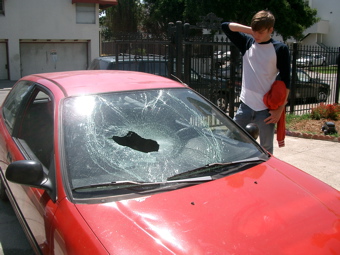
Tom went to a friend’s birthday party in West Oakland last night. Locally, saying "West Oakland" or "East Oakland" can be code for "mostly poor and mostly crime-ridden." The plan was for Tom to spend the night at his friend’s place; Kate and I were OK with that since he wasn’t going to be abroad in the neighborhood, which, frankly, can be dangerous at night.

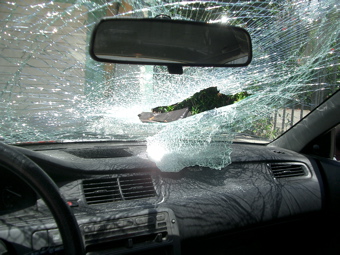
The phone rang about 1:30 in the morning. I don’t like middle-of-the-night calls simply because they’re usually wrong numbers or bad news. I had been asleep and wasn’t able to get to the phone before our voicemail kicked in, but I wasn’t assuming the worst: Tom’s always been great about checking in with us when his plans change, and he knows we’d rather he wake us up is something’s going on that we ought to know. I called our voicemail, and there was a message from him: His friend had come out of his house to find Tom’s car, parked on the street in front, fairly seriously vandalized: smashed windshield, smashed passenger’s-side window, and crushed-in roof — apparently someone had climbed on the car and jumped up and down on it.

I listened to the message, and before I could call Tom he called back. He was pretty upset, but he was handling things pretty well: He and his buddies had pushed the roof back out, and he had already thought through calling the police and the insurance company. I was pretty calm, for me — just angry over the wanton destruction involved, really; the important thing was that Tom and his friends were all OK.

Later on, Tom called the police; in Oakland, the cops apparently don’t bother to send anyone out for cases like these, and they took the report over the phone. Then he and a friend drove the car to her house so he could park in her gated driveway — it was only a matter of time until some passerby started impromptu salvage operations on the car’s interior. Kate and I drove down to meet him there — the scene above. Looking the car over, it looked like all the damage came from one person — the same footprints were all over the roof and on a couple of windows that he apparently tried and failed to break. I drove the car the slow way back to Berkeley. I thought maybe I’d get some reaction from people on the street — "Hey, what happened to your car?" — and I had a good line ready: "Just got it detailed!"   

Now, I just feel bad for Tom. He and some of his friends have grown attached to it during their trips to concerts, and he calls it the "Machine Messiah." It’s just sad to see your wheels trashed. But he says, "The Machine Messiah will roll on."