Hurricane Hastert

I’m proud to be a native of the state that produced Speaker of the House Dennis “Hurricane” Hastert. At last, a common-sense politician brave enough to speak his mind. As all around him wring their hands over the catastrophe in New Orleans, Hastert alone is clearsighted enough to see beyond the suffering and try to chart a sensible course for tomorrow. “It doesn’t make sense” to spend federal money to help rebuild the city, he said. And: “It looks like a lot of that place could be bulldozed.” Sometimes that’s the toughest thing: having the courage to move on.

Hastert noted that federal money is spent on rebuilding other disaster-prone locales sometimes: “But you know we build Los Angeles and San Francisco on top of earthquake fissures and they rebuild, too. Stubbornness.” (I like the fissures part; he must have seen that in “Superman”).

There’s a cost, of course, to such plain-spokenness. People who’ve lost their city react emotionally to your ideas. The principled thing to do amid the wounded yowls is plow straight ahead and enlighten the folks about the careful reasoning behind your blunt honesty. You might say something like this — or at least Hurricane Hastert did:

“ I am not advocating that the city be abandoned or relocated. My comments about rebuilding the city were intended to reflect my sincere concern with how the city is rebuilt to ensure the future protection of its citizens and not to suggest that this great and historic city should not be rebuilt.”

Truly: A profile in courage.
Katrina: The Real Story

What the media isn’t telling you (and you should be glad):

That Katrina was a weather weapon, wielded by the Yakuza, the Japanese mob. Or maybe Russia. Or China. Or India. Idaho weatherman extraordinaire Scott Stevens promotes this view, based on the belief that the Soviet Union developed energy weapons that can manipulate the weather, set off earthquakes, and mundane things like disable satellites and spacecraft. Stevens appeared on a podcast called the Enigma Report just before Katrina hit the Gulf Coast. He told host Kathleen Keating that Katrina’s Florida landfall was a smoking gun:

SS: As I was doing my evening weathercast the Thursday prior, the evening of the 25th of August, I was reading the discussion out of the NHC where the eye of Katrina as she made landfall went over the top of the NHC. If that isn’t putting … let’s just say you’re putting the bead of the eye of the gun on the target. It was amazing. That should have been a big heads up. …

KK: To me that was Yakuza all over. To me that was like their signature.

SS: Yakuz … yeah. It was a very clear signal that you’ve been targeted; you’ve been targeted.

And a little later, he explained that the Yakuza was just one possible culprit: “It could be Yakuza, It could be the former Soviet Union with this. There was China involved. There is India now. There are so many nations that all they have to do is do their little part to keep this thing going.” He also noted that all the planes leaving suspicious contrails over most of the United States had migrated to the region where the storm was active. Of course, neither he nor the host ever explain how storms like this happened before the onset of supersecret Soviet technology.

Now here’s the thing if you spend the time to listen to this guy’s Yakuza/energy weapons claptrap: You’ll find much of what he says thoughtful and perhaps agree with it. For instance, how the destruction of wetlands in Louisiana has contributed to New Orleans’ vulnerability to catastrophic flooding; or how irresponsible it is for our government to commit hundreds of billions to the Iraq war. And he’s reasonably well informed about the economy and the Gulf region’s place in it.

Then he caps everything off by noting that our side failed to do anything to fight the enemy hurricane warriors, whoever they are, and ends by saying, “The great sorting has begun.” Meaning the apocalypse is here, I guess.

Hurricane Relief: Mission Accomplished

On Monday, as Hurricane Katrina was beginning the process of turning New Orleans and the Gulf Coast into something like hell, the president was talking up all the great things he’s done for Medicare recipients at a senior center in Southern California. He wanted to touch on some current events, though, before he started into telling everyone how much better he’d made their lives:

“… We’re praying for the folks that have been affected by this Hurricane

Katrina. We’re in constant contact with the local officials down there.

The storm is moving through, and we’re now able to assess damage, or

beginning to assess damage. And I want the people to know in the

affected areas that the federal government and the state government and

the local governments will work side-by-side to do all we can to help

get your lives back in order.

“This was a terrible storm. It’s a storm that hit with a lot of ferocity. It’s a

storm now that is moving through, and now it’s the time for governments

to help people get their feet on the ground.

For those of you who prayed for the folks in that area, I want to thank you

for your prayers. For those of you who are concerned about whether or

not we’re prepared to help, don’t be. We are. We’re in place. We’ve got

equipment in place, supplies in place. And once the — once we’re able

to assess the damage, we’ll be able to move in and help those good

folks in the affected areas.”

“For those of you who are concerned about whether or not we’re prepared to help, don’t be.” He didn’t quite say “mission accomplished.” But you have to view the clip — Bush with his cocksure “we done showed Saddam” smirk — to see that he really was saying “mission accomplished.”

Where Hurricanes Come From

Sitting in Chicago yesterday, observing low clouds rushing south on a gusty northerly breeze — part of the larger circulation of what was left of Hurricane Katrina, hundreds of miles away — my brother John asked something like, “How do hurricanes get started?” I fumbled for a few minutes talking about some of the ingredients that go into a hurricane — warm, warm ocean water, the little atmospheric disturbances that sometimes kick off the big storms, and weak wind shear (vertical winds) that allow the storm’s circulation to get moving. But I realized, gee, beyond those haphazard scraps, I don’t really know.

The question itself is kind of profound, because a quick look through some online references show that while more and more is understood about the process, even supercomputer-wielding climate scientists can’t give a final answer to how the storms start. Obviously, hurricanes get lots of attention from serious science; the lack of complete understanding says a lot about how complex weather processes are.

A few “how hurricanes form” links:

–If you love the Socratic method and aren’t afraid of brushing up against a little high-level science talk, the National Hurricane Center has an insanely long list of frequently asked questions about the storms. To zero in on hurricane origins, go to the basic definitions page and check out “how do tropical cyclones form?

–Lots of more basic explanations are available, including at How Stuff Works. NASA’s kids site has good pages on how hurricanes are created and how they move.

Flying Home

Heading back, watching the night unfold, watching the towns approach, slide past,

right-angle layouts, the bright stitching of main streets against invisible landscape.

I can guess the names of the bigger towns: Rockford. DeKalb. Galesburg. Iowa City. Cedar Rapids. All maybes. Nothing big enough to suggest Des Moines or Omaha. Then the smaller towns. Some I’ve passed through, others are just names I’ve picked up along the way. Dyersville. Grinnell. Ottumwa. Story City. Stanhope. Storm Lake. Then across the invisible Missouri: Grand Island. McCook. Hastings. Ogallala.

But most without any names that I know, though I’d love to learn them. All down there somewhere in that thinning web of settlements as we move west, each town throwing its main-drag strands of light into the dark. Island universes in uncounted numbers.

[Translation: United Flight 385, Chicago to Oakland. Took off 8:45 p.m. CDT, landed 10:45 p.m. PDT.]

A Day in Greater Chicagoland

Towpath

We drove from Dad’s place on the far North Side out toward Joliet, southwest of the city, to find the spot where the Des Plaines and Kankakee rivers come together to form the Illinois.

The first 99 percent of the route is straightforward: If you like, you can drive to within a few miles of the spot on Interstate highways. But we got off the expressway and took side roads to follow the dual channels of the Des Plaines and the Chicago Sanitary and Ship Canal. The side roads weren’t pastoral lanes; we drove past one tank farm and refinery and generating plant after another. Eventually we turned away from the Des Plaines and drove west and south through brand new subdivisions — some half built, some just surveyors’ markers outlining streets and lots for homes that will go up next year; one neighborhood with a long curving boulevard of fresh asphalt and a giant new playground and not a single home even under construction yet. We eventually passed through a place called Minooka, which must have been a quiet little crossroads once. We crossed a highway at a strip mall called Mallard Point and drove south about a mile to a T intersection where we met my brother John, his wife, Dawn, and their two kids (Sean and Leah) who had driven over to meet us from my other brother’s place).

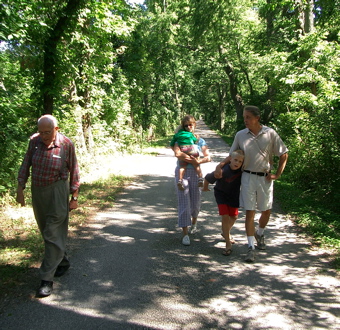
After wandering around on a couple of country roads, we finally figured out that the road to the confluence depicted on one of our maps was actually the towpath to the old Illinois and Michigan Canal — the link that in the mid-19th century connected Chicago and Lake Michigan and all points east to the Mississippi River and the interior of much of the United States. We hiked down the path for maybe three quarters of a mile, to where the conjoined rivers go through a lock and dam. A little short of the confluence, but close enough for today. Everyone was still smiling on our way back to the cars.

Reality TV

Katrina

Watching the relentlessly turgid cable news coverage of Hurricane Katrina, I wonder: How long until Mark Burnett, the brain behind CBS’s "Survivor" franchise and many other reality TV series, gets into staging programming for natural calamities (or potential calamities) like this? Don’t laugh. Roone Arledge made his name in sports television for ABC and wound up taking over the network’s news division. The next logical step is to bring Burnett’s sense of drama, character, pacing, and production values to set-piece stories. To the extent that Arledge and many others have pushed news toward entertainment — an old development — both producers and consumers long ago started to make this shift.

Of course, most of the people doing electronic news are bad at both  journalism and entertainment. So the problem for Burnett would be he’d have to undo much of what news divisions have undertaken to appeal to their audiences: the flimsy veneer of theatrics laid over every square inch of a story like a hurricane. He’d have to find a few good Jeff Probst types to act as team leaders/anchors, and a bunch of adventurous and photogenic amateurs to send to the beaches to get blown all over the place. Maybe he’d set up competitions to decide who gets what storm-coverage assignments: winners of a challenge might get to stay inside a well-fortified four-star hotel while losers would have to ride out the storm on the beach.

As cheesy as this all sounds, it would almost be preferable to watching the news pros knit their brows and search for words to convey what a horrible spectacle nature is unleashing.

Random Reading

A product of random reading:

On September 4, 1886, the Chicago Tribune critiqued a pamphlet on a now-forgotten political scandal by a now-forgotten writer: ""The pamphlet on the Paine Bribery Case and the United States Senate, by Albert H. Walker, is plainly the effusion of a crank."

Mr. Walker was an attorney, author of a textbook on patents, who apparently took himself very seriously. The Tribune’s choice of words prompted him to sue for libel. Walker filed a declaration in federal court in Chicago that said the Tribune had published the remark "to cause it to be suspected and believed that plaintiff was a man of crude, ill digested, ill considered, and wild ideas and aims, and to be supposed to be without skill, tact, adequate information, or common sense." Furthermore:

"… to publicly characterize the plaintiff as a "crank," and thus to publicly impute to him sundry qualities, aims, and methods highly inconsistent with usefulness and success as a lawyer and author, … plaintiff has been greatly prejudiced in his credit and reputation, and caused to be considered an unreliable and injudicious person, and destitute of those qualities on which the earnings of a lawyer or a serious author depend; and has been greatly vexed and mortified, and has been deprived of divers great earnings which would otherwise have accrued to him in his professional duties, and divers great royalties which otherwise would have been paid to him on sales of his books."

Walker also noted that since President James Garfield’s assassination in 1881 at the hands of Charles J. Guiteau — widely described as a crank — "the word … has obtained a definite meaning in this country, and is understood to mean a crack-brained and murderously inclined person, and is so used by the public press."

The court wasn’t moved by Walker’s entreaty to help him recover his reputation. It granted the Trib’s motion to dismiss Walker’s claims, resorting to Ogilvie’s Imperial Dictionary to support its finding that "the word would seem to have no necessarily defamatory sense." In fact, the court’s opinion (Walker v. Tribune, 1887) suggested Walker get a thicker skin: " It is no libel upon a man who has entered the field of authorship to underrate his talents."

Despite the trauma of being called a crank by no less an august organ than the Trib, Walker managed to make a living afterward. His patent textbook went through at least four editions. He lectured on patents at Cornell. And he wrote one of the first books on the Sherman Anti-Trust Act, still circulating today.

Today’s Good News from Iraq

By way of Iraq Coalition Casualties, I note this press release from the U.S. Central Command about an incident in Operation Fight ‘Em Over There:

TWO KILLED DURING INCIDENT AT ALI BASE

The release describes an incident in which U.S. troops shot and killed two apparent intruders at a U.S. base in Iraq; a third person was wounded. Nothing unusual there — I hear there’s a war on. But the release goes on to say:

“The professionalism of the men and women, who quickly responded to this incident, prevented any harm to the more than 9,000 Air Force, Army and Coalition members on and around this installation,” said Col. Michael J. Nowak, 407th Air Expeditionary Group commander.

“Security forces personnel flawlessly executed their job in service to the nation and met the challenge of providing force protection of the installation’s perimeter,” he added.

It’s nice that, while war is still hell, the boss takes time out to give the troops a pat on the back for a job well done. I wonder if this is a first in glowing media alerts for well executed killings. I wonder if, in the same spirit of tellin’ the folks back home about the job we’re doin’, Central Command will tell us more about shootings like this one. And this one.