The Street Where You Live

Let’s just say you walked out to your car, the way you do every day if you have a car, and you looked in and saw the stereo was gone. Neatly and completely removed.

It happens. No sense getting too worked up. Nobody’s hurt, after all.

But what if it’s the third time it’s happened in this particular car, parked in the middle of your safe, seemingly immune little middle-class neighborhood (and when the stereo isn’t being ripped off, the car’s roof and hood are being kicked in or the windshield smashed)?

Then maybe you start thinking about all the other things that have happened on your safe, seemingly immune street since you moved in back in the late ’80s. You recall in no particular order:

The rapist who was caught after casing the house across the street.

The two laptops someone scooped up from your desk after smashing your kitchen window while you were out at the ballgame.

The innumerable late-evening front-door encounters with victims of empty gas tanks, freeway wrecks or other fictional misfortunes who just needed five or ten bucks to help them deal with the emergency.

The random misfortunate who snatched a purse from a neighbor’s house as the neighbor tried to verify the poor guy’s sketchy story.

The guy who showed up at 1 a.m., pounding on the door and demanding money from your wife while you were working.

The two or three or four other cars broken into in front of your house.

The neighbors who one day couldn’t find their car because it had been stolen overnight.

The stolen car that was dumped on the street, right in front of you, in broad daylight.

The break-in at the across-the-street neighbor’s place.

The break-in at the neighbor’s place three doors up.

The several occasions on which would-be burglars were interrupted while casing targets.

The bikes stolen from the back of your house and from behind one of your neighbors’ homes.

The commuter robbed at gunpoint up the street as he returned for his car after work.

The dad out walking with his kids who had a gun pulled on him during an attempted robbery.

The neighbor whose back-porch Sunday breakfast was interrupted by a guy coming over the fence with a suitcase. The neighbor asked what was going on, and the over-the-fence guy just said, “Stay out of my way” and kept on going.

One way I can look at all this: Hey, no one died. You can replace property, fix windows, buy a new car stereo, and get over your fear and sense of violation. But the way I looked at it when I discovered the stereo gone was not so reasoned and cool. It feels like this place asks a lot sometimes for the privilege of living here, and sometimes I detest the cost.

I’ve got no answers, or apologies, either. Just chewing it over.

Technorati Tags:

Off the Blotter

Berkeley’s hometown paper is the Daily Planet. It’s not daily anymore; the software millionaires who publish it cut it back to two days a week some time ago. It’s mostly a contentious political rag, but it’s better to have a rag of any sort than nothing at all.

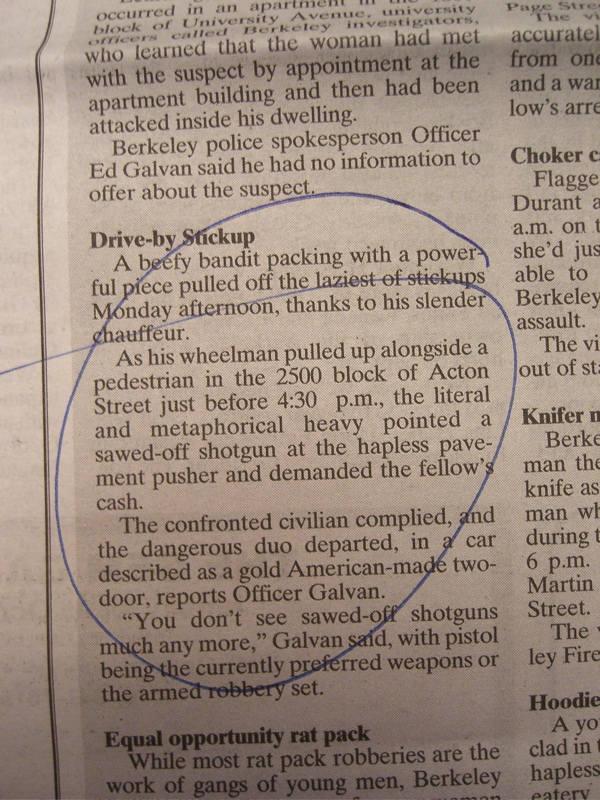
Among its staffers is a guy who covers the city crime beat and produces the police blotter column. I share the widely held affection for and interest in local crime news, but I stay away from the Daily Planet’s cops column. I stay away because it ticks me off a little. It ticks me off because the guy who writes it is unable to restrain himself from exercising what I guess he must believe is a clever take on hard-boiled detective fiction. Here’s an example from the current edition of the Planet:

Blotter102206

Besides the copy that has gone uncorrected (“pistol being the currently preferred weapons or the armed robbery set” is a gem), my compaint is with this guy’s fun getting in the way of his facts. It might be nice to offer some description of the “dangerous duo” beyond the fact one was “beefy” and the other “slender.” And more seriously, an item like this reflects little or no understanding that having a gun stuck in your face is anything but a joke to the guy looking down the barrel. But hey, these are editorial matters, and I’m out of the news game.

I can, however, write a letter to the editor. And issue to issue, the Planet seems to run every screed it gets. So I dashed off the following after putting the coffee on this morning:

Editor:

Thanks ever so much for continuing to entertain the masses with the mirthful musings of jocular journalist Richard Brenneman. Until encountering his cutesy crime chronicles in your pages, I failed to focus on the fun in felonies or the alliterative amusement of misdemeanors. Some may carp and cavil about Mr. Brenneman’s jokey jottings and criticize them as prosey preciousness or doltish drivel. Ignore their nay-saying and nattering. Scrawl on uncensored, say I. Next time I come face to face with a “beefy bandit,” a “dangerous duo,” or any of the other colorful criminals who people Brenneman’s Berkeley, I’ll chuckle as I turn over my wallet, imagining how he might describe the scene.

Technorati Tags:

Their Country

As a great sports talk show guy has been heard to say, it’s not my style to criticize. So I’m not going to get exercised by the Chevy truck ad campaign that’s airing during this year’s baseball playoffs. I’m not going to get upset by the campaign’s appropriation of iconic images from our recent history–Rosa Parks, Martin Luther King Jr., Muhammad Ali, Nixon’s White House departure, a Vietnam combat scene and a Vietnam peace march, a Woodstock clip, New York firefighters, the shafts of light memorializing the World Trade Center, NewOrleans after the flood (which begins a sequence suggesting Chevy trucks have had a big part in helping New Orleans put itself back together). I’m not going to drone on about the irony in John Mellencamp, whose song “Our Country” is the ads’ soundtrack, praising G.M. as a company that looks out for working folk with the company in the midst of putting tens of thousands of people out of their jobs. I won’t so much as mention that Mellencamp is performing the song before Game 2 of the World Series, in effect giving G.M. a free ad for its trucks.

(I might do all those things, but others have beat me to it, including someone who put up a somewhat predictably but still sharp parody on YouTube.)

What I will do is suggest a few clips Chevy might want to add to its paean to itself; or better yet, use them to do a whole new ad.

–GM workers fighting cops and company goons as they sought to organize their plants in the 1930s.

–Street scenes from Flint and other towns GM and other automakers have abandoned. I’m sure Michael Moore would share some of his footage.

–Some film of the Corvair; maybe spliced together with some images of Ralph Nader when he outed the car as “unsafe at any speed.”

–Maybe shots from a GM board meeting where the auto geniuses plot their winning market response to Toyota, Nissan, Honda et al. You could have clips from the ’70s and the ’90s.

–Some beauty shots of the Chevy Suburban and the Hummer. Even better if they’re shown at a gas station. Mix in a satellite view of Hurricane Katrina and some pictures of that Antarctic ice shelf collapsing and maybe some grainy street video of people looking real hot in an urban setting.

–Footage of the aftermath of some of the thousands of fires in the ’70s, ’80s and ’90s involving GM pickups with defective fuel tank designs. It would be extra realistic and downhome to see some amateur video of a funeral or two of the 1,800 people or so who died in the crashes.

Not sure what music would work best for this. “This Land is Your Land” is always a happy, snappy pick-me-up. And maybe close the ad with a statement from the company. Something simple, like “We’re sorry.”

Technorati Tags: ,

Silence

By way of Marie, a post from Chicago crime writer Sara Paretsky on the cost of going along with the war and the rest of it:

“I’ve recently returned from a publicity tour of Scandinavia, where my recent novel Fire Sale was published in translation. While I was there, 40,000 Hungarians—out of a population of 10 million—stood outside their president’s house in silent protest because he had lied about the economy to get elected. In almost every press interview I gave, journalists didn’t have any questions about my work, my deathless prose or my characters, or about me. They wanted to know why Americans weren’t in the streets, or some place, protesting what has been done in our names. They weren’t asking in an aggressive, or censorious way; they were asking out of anguish, because we are so powerful, and what we do affects the whole world.”

Technorati Tags: , ,

Vietnam, Iraq

I joined the Organization of American Historians earlier this year, mostly to get access to its online journal archives; besides, you don’t have to be a real historian to be a member. One of the unanticipated perks is the quarterly Journal of American History. The September issue has a sort of roundtable discussion–it was conducted in email–among a group of scholars who have focused on the history of the Vietnam War. The subject is legacies of the war, and among the questions the journal posed to the historians was this: “Why or why not is Vietnam an appropriate historical analogy for thinking about current U.S. military involvement in Afghanistan and Iraq?”

[The question is in the news, too. The commander-in-chief was asked the other day whether there was some parallel between the Tet Offensive of 1968 and the current bloodbath in Iraq. He allowed there was, then quickly added that since we’ve succeeded in turning Iraq into what it was not before we invaded–a 365-day-a-year, hands-on, post-graduate level training camp for ambitious terrorists–there is no way–no way!–we’ll leave before “the job” is done.]

Back to the historians. They all have much to say about Vietnam/Iraq parallels. But the one who sums them up best (and most dispassionately) is Christian Appy of the University of Massachusetts, Amherst. He says:

“There is a danger that any effort to compare current events with historical antecedents will badly distort both past and present. I agree that Iraq and Vietnam are vastly different … but surely there are commonalities, at least in a general sense, in the way U.S. officials justified their policies in the two countries, and these analogies can serve public debate. After all … one important connection is that U.S. policy makers then, as now, believed detailed local knowledge was largely irrelevant except in narrowly tactical terms (that is, where are the “bad guys”?) because Washington clung to the hope (in spite of massive contrary evidence) that U.S. technology and military firepower could hold the line long enough for modernization (or nation building) to draw each country into a stable global system amenable to U.S. economic and political power.

“At the risk of gross oversimplification, I’d like to list a few linkages. Then as now, the president claims:

—We face a global threat (Communism/terrorism).

—The enemy we fight is part of that global threat.

—We fight far away from home so we won’t have to fight in our own streets.

—We want nothing for ourselves, only self-determination for them.

—We are doing everything possible to limit the loss of civilian lives.

—We are making great progress, but the media isn’t reporting it.

—Ultimately, the war must be won by them with less and less U.S. “help.”

—Immediate withdrawal would be an intolerable blow to U.S. credibility and would only embolden our enemy and produce a bloodbath.

—Antiwar activism must be allowed but demoralizes our troops and encourages our enemy.

“Then, as now, the president does not say:

—The enemy in Vietnam/Iraq actually does not pose a threat to U.S. security, but we’re fighting anyway.

—We do indeed have geopolitical and economic interests in the region and will never tolerate a Communist/radical Islamist government.

—We are using weapons and tactics that don’t distinguish between civilians and combatants.

—We will stretch and break the law to spy on and sabotage antiwar critics.

—We won’t ask the nation as a whole to make a major sacrifice but will continue to send the working class to do most of the fighting.

—The progress we report is contradicted by our own sources.

—Troop morale is going downhill.

—Most of the people over there don’t want us in their country.”

Technorati Tags: ,

Today’s Top Concepts

Zebra101806a_1

Zebra101806b_1

Continue reading “Today’s Top Concepts”

Just What He Appears to Be

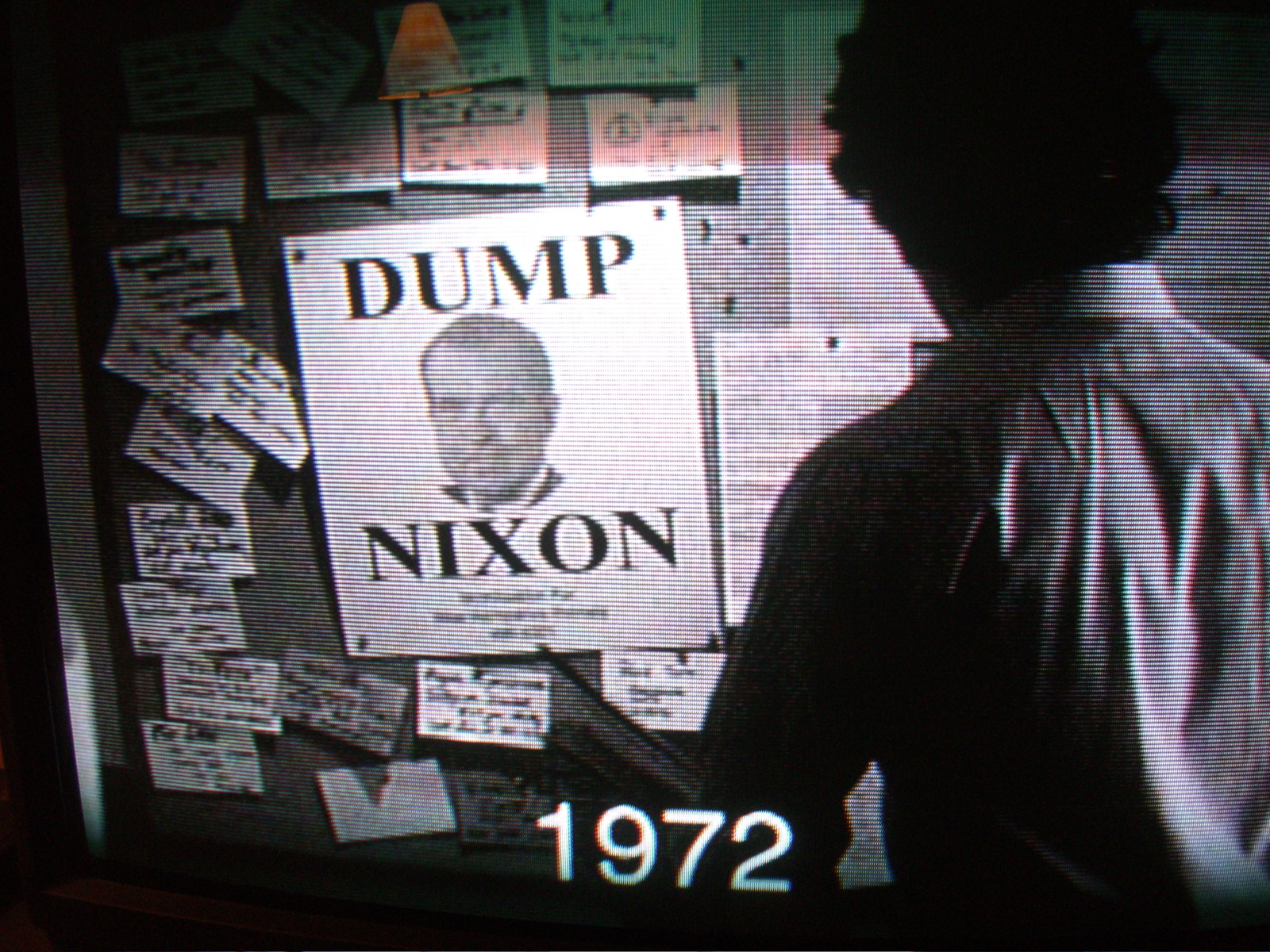
Dumpnixon

Phil Angelides, the Democrat allegedly running for governor against Arnold Schwarzenegger, is metamorphosing from forgettable also-ran to oddball footnote. I’m sure he’s still out on the stump telling people about his middle-class tax cut and all the good things he would do if he’s elected. That’s the forgettable also-ran part, and too bad, because Angelides has earnestness to spare, some idea of what the state needs, and the willingness to try to get people to pay for the things they want the state to do (translation: he’ll talk about tax increases). Schwarzenegger, who reverted to form as an ill-spoken, bullying boor during the one face-to-face meeting of the campaign, continues with the fiction that the state can do everything it wants without ever raising taxes. Popular message, though no one is talking much about how Arnold managed to balance the budget after he took over in 2004: the state took out a second mortgage to cover a catastrophic deficit; eventually, someone’s going to have to pay that money back. But I digress.

So the handwriting’s on the wall for Angelides. He’s way, way down in the polls and headed for a repeat of Kathleen Brown’s humiliation at the hands of Pete Wilson in 1994 (she lost 55-41). In his darkest hour, though, he’s begun a TV ad blitz with a new spot. This is where he’s bidding to become an oddball footnote: The ad, which tells in 30 seconds about Angelides’s lifelong commitment to public service, is so off-key in conception and message it seems loopy.

It opens with a silhouette of a guy looking at a bulletin board with a big “Dump Nixon” poster. As the silhouette hurriedly scribbles notes, a voiceover says, “In 1972, a young man from California saw a sign that changed his life forever and inspired him to make a difference.” Then we go to a montage of Angelides’s career. Among other accomplishments, he “led school reform in his community and helped California make history.” The ad notes that he’s been called “the most effective and dynamic state treasurer in a generation.”

I’ll pause to let you catch your breath.

Then there’s the background music. As the empty phrases and pictures flit past, the Bellamy Brothers sing “Let Your Love Flow.” (If you need to remind yourself what that sounds like, you can play the ad on the Angelides site or on YouTube.) Maybe there’s a coded message in the lyrics (“There’s a reason for the sunshine sky/There’s a reason, I’m feeling so high…”). Otherwise, it sounds like something the candidate or his wife finds inspiring. That’s the kind of information I wish had been disclosed before I voted for the guy in the primary.

What you can say for the ad is that it takes the high road. It alleges that Phil will fight for me and that he’s always been on my side. It’s also sweet and sticky as treacle and doesn’t tell me one thing to get me to admit to someone else that I’m casting a ballot for this candidate or suggest to them that maybe they should think about doing the same. “Dump Nixon”? Who’s that supposed to win over? Are we supposed to be impressed that that lit a fire under him?

You wonder if people can make heads or tails out of any of it. You’d think the money could be better spent on ads or a Perot-style TV appearance to lay out what this guy would do for the state and why it might be necessary to raise taxes for Californians to have the state they say they want to have.

Technorati Tags: ,

The News from Iraq

Link: Number of Embeds Drops to Lowest Level in Iraq.

So, the news from Iraq is bad. But maybe we’re lucky we’re getting any news at all. The Associated Press has a story today on the number of journalists now "embedded" with U.S. troops in Iraq. From a high of 600 at the war’s glorious beginning, participation has dropped recently to 11. Eleven. Fewer than a dozen reporters and news organizations out with the troops to find out what’s happening on the streets and in the countryside. The rest of the news gets reported out of the Green Zone in Baghdad or secondhand through Iraqi stringers.

Not that the embed system is wonderful. It’s not. It puts reporters in an impossible position if their aim is to report events with some sense of independent clarity. As the AP story notes, the military doesn’t censor journalists’ work; but reporters whose coverage upsets commanders have been reprimanded or kicked off their embed assignments altogether. Unfortunately, the situation in Iraq–the omnipresent violence, the insurgents’ tactic of targeting reporters–makes embedding the only way journalists can do something akin to in-the-field reporting without committing suicide.

So: Why are so few reporters embedding now? The story offers three reasons: Declining public interest in the story; news organizations’ unwillingness to spend what it takes to get reporters into embeds; and the bureaucratic and logistical hurdles news organizations must overcome to just get a reporter into an embedded situation. (I find the "declining interest" argument unpersuasive; if people aren’t paying attention to Iraq, then why is Bush working overtime to persuade us all what a necessary thing it is? The other two reasons both hold water.)

Link: Number of Embeds Drops to Lowest Level in Iraq.

Today’s Body Count

Image001
Number of U.S. soldiers, Marines and sailors killed in Iraq in October.
Image002

Number of deaths in October among Iraqi security forces and civilians.

Details: Iraq Coalition Casualties.

Technorati Tags: