The Control of Nature: Primitive Hydraulics

Sunday morning: Still raining.

We’ve had .42 of an inch so far today (it’s 1:30 p.m. daylight-saving style) to go with the 6.48 over the past nine days.
The rain has prompted me to return to an old wet-weather routine that Kate and I have called, in a nod to a favorite writer and a favorite series of articles in The New Yorker, “the control of nature.”

When we moved into our house in April 1988, it was noted in some document somewhere that there was a sump pump on the premises. I found out where the pump was and why it was there the following winter.

Our house has a crawl space. Our lot is on a slope paralleling the course of Schoolhouse Creek. The stream itself has been moved underground, but as we found out one very wet December day a little more than 10 years ago, too much water arriving all at once can, along with a clogged storm drain upstream, bring the creek back above ground.

Water appears less dramatically in our crawl space, and that’s why there’s a sump pump down there.

Usually, a murky pool will gather in a spot that’s been excavated to allow access to the crawl space. Sometimes, as in deluge that arrived early the morning of New Year’s Day 1997, the space will start to fill. That was the one and only occasional the pump, installed in a little concrete well built around our floor furnace to keep the heater from getting flooded, turned on.

Perhaps one reason the pump hasn’t been more active is because I try to keep the crawl space drained when I see water gathering there.

Control of nature requires gravity and a garden hose. I take the full hose, stick one end of it into the watery crawl space. Then I run the hose down the driveway — 30 to 40 linear feet and 3 to 4 vertical feet — to the street.

I set the hose running last night about 9 o’clock. It’s still running. How much water has come out of there in that time?

I tried to calculate the rate by measuring the flow into a 1-cup measure (yes — this has the possibility of introducing a large error; but let’s just agree I’m not being perfectly scientific). In four trials, the cup filled up in about 6 to 7 seconds. Based on that, I figure somewhere between 32 and 38 gallons are draining out every hour. And that would put the total for the 15 hours or so the thing has been running at 480 to 570 gallons. Which is more than I would have guessed.

Berkeley Rainfall: Six and a Half Inches in Nine Days

While I’m poring over state and federal databases and pondering what it would be like to live through a year with 145.9 inches of rain (Cooskie Mountain, in the King Range of southern Humboldt County, in 2006) or a month with 43 inches of rain (Gasquet Ranger Station, on the Smith River in Del Norte County, December 1996) or 42 inches in nine days (yes, it happened: Bucks Lake, Plumas County, in January-December ’96-’97), let me record what we have actually seen here in Berkeley the last week or so:

Friday, March 4: .46 inches
Saturday, March 5: 2.61 inches
Sunday, March 6: .50 inches
Monday, March 7: .46 inches
Tuesday, March 8: 0
Wednesday, March 9: .13 inches
Thursday, March 10: .87 inches

Friday, March 11: .46 inches
Saturday, March 12: .99 inches (and counting)

That’s a total of 6.48 inches in nine days, as recorded on our cheap, semi-dependable (it’s very close to neighboring totals reported on Weather Underground) Oregon Scientific wireless rain monitor.
A pretty rainy spell, the rainiest this winter by far.

Talking About the Weather

“When two Englishmen meet, their first talk is of the weather; they are in haste to tell each other, what they must already know, that it is hot or cold, bright or cloudy, windy or calm.”

–Samuel Johnson, quoted in “The Invention of Clouds,” by Richard Hamblyn

Berkeley Love Affair: Free Crap

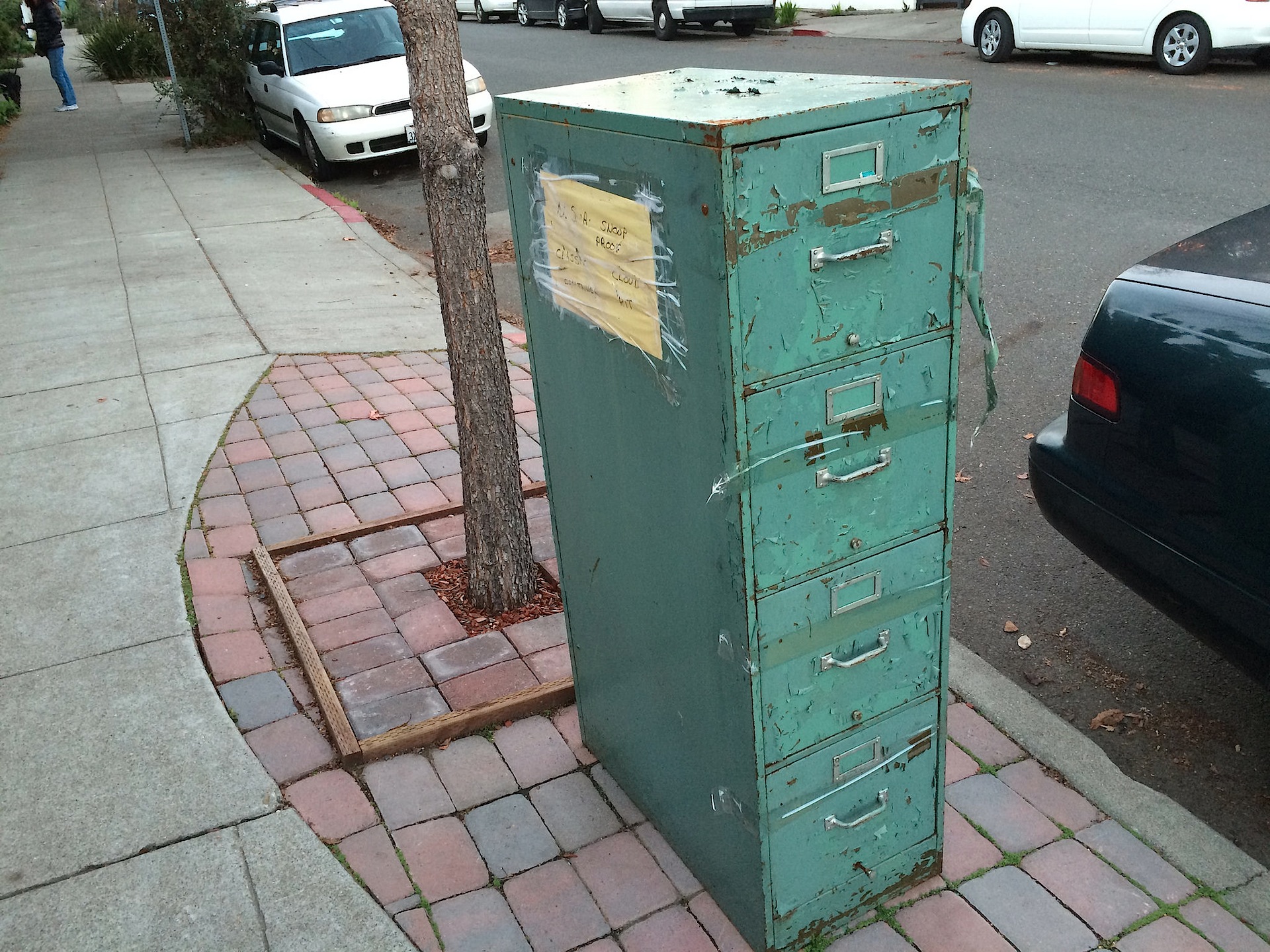
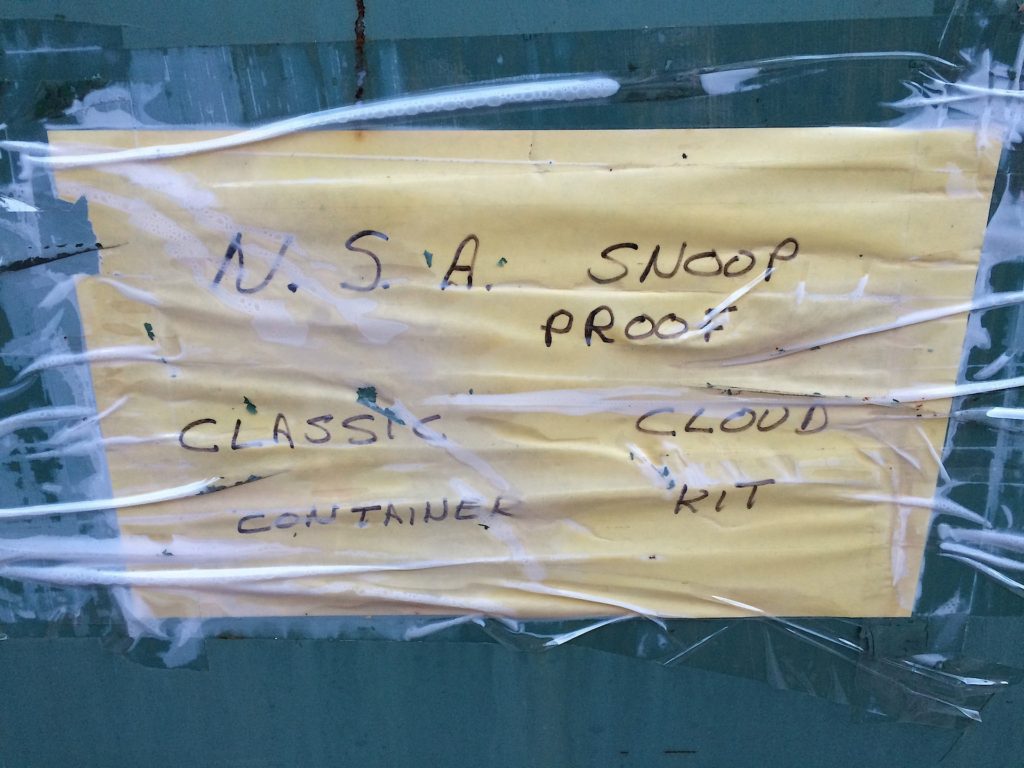
Yours for the taking: “N.S.A Snoop-Proof Classic Cloud Container Kit.” Also known, if you haven’t seen one before, as a filing cabinet.
Among the slow-motion trends we observe in our corner of Berkeley is the proliferation of white elephant items left on the streets — everything from ratty furniture to unwanted books to antique all-in-one office machines (complete with manuals) — with signs saying, “Free.”

It’s not that the stuff is all garbage. Kate and I found a kind of abstract art print in decent condition a year or so ago and brought it home and hung it up. Maybe that’s more of a statement about relaxed taste than artistic merit, but we felt it was worth the effort to pick up and carry home and didn’t change our minds when we took a second look at the thing.

For the most part, though, what you see out on the curbs and at the end of driveways is crap of dubious utility. It’s stuff put out on the street with the hopeful delusion that even though your dog finds the old couch repulsive, someone out there would be happy to have it. They would welcome the chance to fumigate and reupholster it. After all, it’s free.

Every once in a while, though, someone dumps their castoff item in the public right-of-way with a note that seems to say, “Who are we kidding? This is junk, but we’re leaving it out here for the amusement of you, the passer-by. Maybe you’ll even take it away.”

Witness the item above (and attached message, below), a dated piece of office equipment with a topical note appealing to those who wish for the days before everything we do could be captured on a server somewhere and preserved forever.

A note to entice you, the passer-by, to consider owning a piece of crap left on a Berkeley sidewalk.

2016, and I’m Thrilled to Be Here …

Science Friday filled its New Year’s Day show with some greatest hits segments, including an excerpt of an interview that Ira Flatow did with filmmaker Werner Herzog, novelist Cormac McCarthy and physicist Lawrence Krauss in 2011. It’s an absorbing 21 minutes, and I’ll have to go back now and listen to the longer version.

At one point, Herzog made an observation about the transience of human life on Earth: “It’s quite evident that human beings, as a species, will vanish and fairly quickly. When I say quickly, maybe in two or three thousand years, maybe 30,000 years, maybe 300,000, but not much more, because we are much more vulnerable than other species, despite a certain amount of intelligence. It doesn’t make me nervous that fairly soon we’ll have a planet which doesn’t contain human beings.”

Herzog explains that while it’s a possibility humanity could self-destruct, he’s really thinking more about “events … which would instantly wipe us out.”

You know — events like the Dinopocalypse.

Krauss readily agrees that a catastrophe is “likely to happen. That will inevitably happen anyway.” He adds that one of the rosier scenarios he sees for our kind is that we’ll eventually be superseded by our own creations — the computers.

Then he offers this takeaway:

“So I think, you know, we may disappear as a species just because we become irrelevant, as well as being destroyed. But I don’t think that’s a bad thing. That’s just – that may be the future. . . . We shouldn’t be depressed if we disappear. We should be thrilled that we’re here right now. . . . That just means we should make the most of our brief moment in the sun.”

New Year’s Eve

fern151231.jpg
It isn’t exactly a New Year’s Eve tradition, but the last few years Kate and I have wound up spending a good part of the last day of the year outdoors. The last couple of years, we took walks up onto local ridges with wide vistas and clear views of the sun setting on 2013 and 2014. Today was a little different: We did something of a public service outing, with the goal to pick up trash along Lagunitas Creek in Marin County. Beyond being a beautiful stream through the redwoods — a forest regenerated after the area was clear-cut in the 19th century — Lagunitas Creek has one special claim on the region’s attention: It’s home to a run of endangered coho salmon. We actually heard, and saw, a couple of the big fish on a little-visited stretch of the creek. And there was plenty else to see too in the forest: ferns (like the one above) and moss and fungi galore. There’s a slideshow of the day’s expatiation here: Lagunitas Creek, New Year’s Eve. The day’s haul: about 10 pounds of crap. The only semi-exotic object we captured was a single Nike flip-flop. Beyond that: beer bottles, beer cans, some candy wrappers.
And, that’s it for 2015. Have a fine 2016, one and all.

Ice, or The Grip of Berkeley’s Frigid Winter Revealed

ice2.jpg

ice3.jpg ice1.jpg

Dramatic evidence of the frigid depths of Berkeley’s brutal winter: ice in the improvised backyard watering dish for the chickens. This has happened twice even though the recorded air temperature from a sensor about 6 feet off the ground in back of the house hasn’t been lower than 36 degrees this week and I don’t see reports from any of the many Wunderground and other stations in the area of readings of 32 or lower. Berkeley’s record low for Dec. 29, for what it’s worth, is 30, set in 1905, and the average low for December, going back to 1893, is 43.7. (The town’s all-time low was set Dec. 22, 1990, and coincided with a Christmas visit by family members who thought they were visiting someplace warmer than Chicago.)

Yes, there are some physical explanations for how water can freeze even if the ambient air temperature isn’t yet freezing — evaporative cooling, for one, and the fact the ambient temperature can be colder at ground level then it is a few feet above.

Marmalade + Winter = Ants

ants.jpg

It’s been a little colder than normal here in Berkeley — and as wet as the weather annals say we have a right to expect — so ants are looking for warmer, dryer digs. They like it when you give them a little extra encouragement. An open sugar jar or compost container might attract an overnight bug invasion. And so might a smidgen of orange marmalade left over from breakfast.

It took a few hours, but the ants found that little bit of sugar, which had spread out into a nice globule on the stainless steel at the edge of our range top. They gathered around the marmalade like they were at a trough. There weren’t a lot of them coming and going; mostly, this group found the good stuff and I think they were forgetting to run back and tell their pals about it.

Unfortunately, I have to acknowledge wildlife was harmed after I made this picture. I got a sponge and wiped up the marmalade and the ants with it. Their cousins are still around, though, scouting out the next feed.

Gleanings from a Parish Register

vtls000632024_002.jpg

Part of the family lore I absorbed long ago was the emigration of my mother’s mother’s family — the O’Malleys and Morans — from a place called Clare Island. I’ll call it a speck of rock standing at the very edge of the Atlantic on Ireland’s western coast, but with the stipulation it’s a good-size speck, maybe three miles wide at its widest point by five miles at its longest. The terrain is dramatic. Cliffs dominate much of the island’s coastline, and on the northwestern quarter of the island, a mountain rears up 1,500 feet from the Atlantic Ocean.

I went to the island once, long ago, and it seems hardly a day passes that I don’t think of it. Maybe that journey was left unfinished in some way. That’s another story for another day.

I have accessed my family’s story there another way, though, one that has involved scores if not hundreds of hours of looking at census returns and other genealogical records online. It’s been sort of thrilling to find the family I grew up hearing my mother describe in the census registers and to seize a few kernels of that history.

Just one example: In 1894, my great-grandfather Martin O’Malley arrived in the United States and settled with his in-laws, John and Bridget Moran, in a neighborhood just east of Chicago’s Union Stockyards. I got the date of his emigration from his 1910 naturalization papers; and the address comes from the Morans’ longtime domicile on West 47th Place. In 1897, Martin’s wife, Anne Moran O’Malley, brought their eight children to Chicago.

The family shows up in the 1900 census on West 47th Street, about half a block from the Morans. Under “Occupation,” Martin and his two eldest sons, Patrick and John, are listed as “labor at yards.” The third eldest son, Mike, was listed as a “messenger boy,” and I’m guessing he worked in the yards, too (he later became a butcher and owned his own shop a couple miles south of the stockyards). So, we have documentary proof of the family’s existence, with enough specificity about ages — someone went through the ages of the O’Malley kids and “corrected” them at some point — to make you feel like your looking at something precise.

Well, maybe.

One thing I noticed looking at the various records for the O’Malleys — and the Morans, too, though I won’t go into that here — is how much their ages move around. Take Martin O’Malley and Anne Moran: In the 1900 census, he’s listed as having been born in July 1854, which made him 45 as of the 2nd of June, 1900, the day the O’Malley household was enumerated by someone named John P. Hughes. Anne Moran is listed as having been born in July 1864, which made her 35.

All fine. The problems — no, not problems; discrepancies — start the moment you look at any other record concerning the family. I haven’t found the 1910 census record for Martin O’Malley and Anne Moran and their clan. But there is a 1910 naturalization record for Martin, witnessed by two of his brothers-in-law, Anne’s brothers Edward and John. What does it say about Martin’s age? That he was born Nov. 9, 1856, more than two years after the date recorded in the 1900 census.

But let’s not get hung up on one tiny little difference. Turn to the 1920 census record, taken at the O’Malley home on South Yale Avenue on Jan. 6 by a Mrs. Grace Cawley. The birth month and year for household members are not recorded, but ages are. Martin is listed as 60 years old — meaning he was born in 1859 or 1860, a five- or six-year jump from the date listed in the earlier census and three or four years from the date listed on his naturalization. Meantime, Anne’s age had advanced a full 20 years, and she was listed as 55.

Martin died in June 1929, so he wasn’t around for the 1930 census, taken April 9 by a Marion Baker. But Anne was. She’s 67 — meaning her birth year has now shifted backward a couple years, to 1863 or even 1862. Most of her children, all well into single Irish Catholic adulthood by now, were living with her on Yale Avenue. The one daughter born in Ireland, Mary O’Malley, is listed as having been 35 — or born in 1894 or 1895; the 1900 census, which may even be accurate, gives her birth year as 1887.

In 1940, census enumerator Katherine Johnson visited the 6500 block of South Yale on April 6. She recorded Anne’s age as 78, which moves her birth another year back, to 1861 or 1862. Let it be noted that the 1950 census has not yet been released, and won’t be until 2022, so we don’t know what Anne or her household informants said her age was that year. But that is one more historical/actuarial data point to consult moving into the 1950s — the headstone on her grave in Holy Sepulchre Cemetery, the big Catholic marble orchard — my dad’s term — out on 111th Street at Austin Avenue. There, her dates are listed as 1865-1952.

Well, the 1952 part is pretty reliable. But the 1865 part?

Anne was buried right next to Martin, and his dates are given as 1851-1929. Again, the later date is pretty well fixed. But remember that his explicit or implied birth year moved from 1854 to 1856 to 1860 in the census and naturalization documents. Where the heck did 1851 come from? And was he really 14 years older than his wife?

Now enter a parish baptismal register for Clare Island digitized sometime in the last few years by the National Library of Ireland. It’s hard to know how complete it is, but it does appear to contain birth and/or baptism information for Martin O’Malley — or Malley, as virtually all of the O’Malleys are listed in the book — and for Anne Moran and eight of her siblings.

Martin’s parents were said to be Patrick O’Malley and Alice O’Malley, and the book lists just one Martin with those parents. He was born, almost certainly, on June 20, 1852. So if you’re keeping track at home, I think we have five different dates for him from five different sources. Me, I’m inclined to go with the earliest dates, especially since there’s something like a contemporary record of his birth.

Now let’s look at Anne, whose birth has been hovering in the early 1860s. She was the first child recorded for John Moran and Bridget Prendergast. The parish register gives her date of birth and baptism as July 19, 1860. Again, virtually every later record gives a different actual or implied birth year for her.

I grew up with the notion that chronology was something that was definite, fixed and objective, or at least could be. I grew up with a web of family dates in my head — birth dates and anniversaries and dates of death, dates we moved from one place to the other — and I’ve always been the pain in the ass who remembers what date Lincoln was shot (April 14, 1865) and reams of other key historical moments. I can tell you that I was born one April morning at 9:21 a.m. — or at least that’s what the records say — and 9:21 a.m. therefore bears some significance for me.

So the floating dates with these not-so-distant ancestors throw me a little and make me wonder how it all happened. It must have been a combination of things: perhaps a lack of specific records; census interviews in which the informant had only a vague idea of everyone’s age, census enumerators and immigration clerks who were inattentive and sloppy or rushed, and interviewees who might have been a little vain or reluctant to give up personal information or just not too concerned with exactitude.

More gleanings to come.

8992612473_cff7b7f745_k.jpg 8993806628_4511a58385_k.jpg