The War List

Semi-obsessively perusing the death reports on Iraq Coalition Casualties, I thought about where the Iraq war ranks statistically among U.S. wars. Without going into the peculiarities of the numbers I’ve come across, here’s a list of total killed and wounded derived from the current "America’s Wars Fact Sheet" from the Veterans Administration. The VA actually folds the Iraq casualty figures into a total number for the Global War on Terrorism, which apparently combines casualty figures for operations in both the Afghanistan and Iraq theaters. The one change I’ve made to the list is to use today’s sum of killed and wounded in both theaters from numbers available through Iraq Coalition Casualties.

War  Deaths  Wounded  Total 
Civil War 529,332 420,000* 949,332
World War II 405,399 671,846 1,077,245
World War I 116,516 204,002 320,518
Vietnam War 58,209 153,303 211,512
Korean War 36,574 103,284 139,858
Mexican War 13,283 4,152 17,435
American Rev. 4,435 6,188 10,617
Spanish-Am. War 2,446 1,662 4,108
War on Terrorism 2,330 16,356 18,681
War of 1812 2,260 4,505 6,765
Indian Wars 1,000 (Not reported) 1,000
Gulf War 382 467 849

*Number of Civil War wounded an estimate based on non-VA sources; the VA lists Confederate wounded simply unknown.

One other note about the casualty numbers: The VA lists non-combat deaths for the American Revolutions as unknown, so the total who died in both wars is likely much higher. Also, the VA lists about 87 percent of the U.S. deaths in the Mexican War and 83 percent of those in the Spanish-American War as "other deaths in service" — which includes deaths from wounds that weren’t immediately fatal, disease, accidents, and other non-combat causes. In fact, the VA’s listed "battle deaths" comprise a majority of war dead in only World War II, Korea, Vietnam, and the current war.
Where We Come From

A tour of cultural history in the arts section of today’s New York Times:

–“My Lobotomy”: A story about Howard Dully, who as a 12-year-old in 1960 underwent a prefrontal lobotomy at the hands of Dr. Walter Freeman, the pioneer and champion of the procedure intended to pacify “disturbed” patients. The story says Dully “was lobotomized … for no other reason than that he didn’t get along with his stepmother, whose long list of complaints about him included sullenness, a reluctance to bathe and that he turned on the lights during daytime.” Dully has produced a radio documentary for NPR, “My Lobotomy,” which will air on “All Things Considered” this afternoon.

–A Critic’s Notebook offering from Margo Jefferson on Constance Rourke and Zora Neale Hurston and their use of “creative nonfiction” to unearth the cultural traditions of white and black America: “They were out to remap the cultural territories; shift the boundaries that separated folk, popular and high art; explore the American character (what we now call the national psyche). … They began in what I’ll call separate but equal neighborhoods. Rourke wrote about white cultural myths and traditions, iconic figures from Paul Bunyan to Harriet Beecher Stowe. Hurston wrote about the roots and characteristics of black American culture: language, folklore, music and dance, the will to improvise.”

–By way of my brother John, a writeup on a $9 million restoration (your tax dollars at work) of a gigantic (27 feet high, 365 feet in circumference) “cyclorama” painting of Pickett’s Charge at Gettysburg. The painting was one of four identical works made in the 1880s as tourist attractions to be viewed in the round, complete with foreground props designed to make the viewing hall merge into the action. One guy in the story refers to the cyclorama (and others like it) as “the Imax of their day.” Like most old art, the Gettysburg painting has been abominably treated — handled roughly, cut up, stored and displayed in wet, leaky rooms.

‘Anything I Need to Tweak?’

My brother John points out the latest chapter in the saga of former FEMA chief Michael “Superdome” Brown. A Louisiana congressman has released some of Brown’s emails (obtained from the Department of Homeland Security) written during the Hurricane Katrina crisis. Brown’s Bartlett’s-worthy response to a dispatch from a deputy in New Orleans who reported the situation was “past critical”:

“Anything specific I need to do or tweak?”

That could be the motto for the entire Bush administration, from 9/11 to Iraq to this thing. I remember talking to Dad before all this Katrina stuff happened about the pure incompetence of these people. They are simply bad at what they do. They are bumblers. Their behavior isn’t grounded in actions-consequences reality (think back to Ron Susskind’s New York Times Magazine piece from last fall and the unnamed administration guy who dismissed “the reality-based community”). They mistake the competence to accomplish discrete tasks — “the CIA can generate intelligence reports” or “the Marines can kick Saddam’s ass” — for a magic wand that will allow them to accomplish whatever they’ve dreamed up. All they need to do is think up a project — “Let’s build a new house!” — invoke some high-sounding principles — “I want it to look like the Taj Mahal!” — then sketch the thing on a napkin and tell the guys with the shovels, cement mixers and hammers to make it happen. What a big surprise that they wind up with a swampy hole in the ground and a half-built foundation with rebar sticking out at crazy angles.

But these folks are optimists: Everyone’s invited to the house warming. And they’re hard working. Just like the emails say: “Even the president has his sleeves rolled up, to just below the elbow.”

Technorati Tags: ,

Twelve Flagpoles

This morning’s exercise in “there’s a couple hours I’ll never get back”: A list of (some) of the world’s tallest flagpoles. An inquiry prompted by driving through Dorris, California (see last night’s post). Of course, the list is non-authoritative, because it’s based on Web resources; on the other hand, in most cases, someone who should know is cited as giving the height of these flagpoles and I’ve cited sources, both strong and not so strong. Also note that the No. 1 flagpole, the one in Panmunjom, North Korea is not really a flagpole at all but a structure that supports a flagpole at the top; it’s noted in several places that North Korea and South Korea have been engaged in a contest of “can you top this,” and that the North has raised the height of its tower more than once.

1. Panmunjom, North Korea: 525 feet (Source: Guinness Book of World Records)

2. Aqaba, Jordan: 433 feet (Source: Wikipedia)

3. Amman, Jordan: 416 feet (Source: Middle East Online; height also given as 410 feet by manufacturer).

4. Abu Dhabi: 403.5 feet (Source: Middle East Online)

5. Sheboygan, Wisconsin: 338 feet (Source: Sheboygan Public Library)

6. Bahrain: 330 feet (Source: U.S. Flags and Flagpole Supply)

7. Panmunjom, South Korea: 328 feet (Source; Wikipedia)

8, Brasilia, Brazil: 328 feet (source: U.S. State Department)

9. Kuala Lumpur, Malaysia: 312-328 feet (described variously as 95 and 100 meters)

10. Fort Wayne, Indiana: 232 feet (Source: U.S. Flags and Flagpole Supply)

11. Dorris, California: 200 feet (Source: Butte Valley Chamber of Commerce, Dorris Lions Club)

12. Calipatria, California: 184 feet (Source: city of Calipatria)

Falling Back

I’m writing from Eugene. Kate and I are on a quick jaunt up to see Thom. We’ve got an extra hour of sleep tonight, thanks to the end of daylight saving time. And tomorrow, an hour less afternoon light on the trip home. That’s OK. I’ll take the extra hour of sleep.

Let it be noted that after next year, the appointed dates for falling back (and springing ahead) will be changed as part of the new energy law passed and signed earlier this year. Beginning in 2007, clocks will be turned forward the second Sunday of March (instead of the first Sunday of April) and turned back on the first Sunday of November (instead of the last Sunday of October).

Compulsively scrabbling for a little daylight-saving history, I note that 2007 will also be 100th anniversary of the publication of the pamphlet that eventually led to adoption of seasonal clock changing. A well-known London architect and builder named William Willett proposed the scheme in his cheerily titled “The Waste of Daylight.” Willett described the ill he wanted to cure:

“… For nearly half the year the sun shines upon the land for several hours each day while we are asleep, and is rapidly nearing the horizon, having already passed its western limit, when we reach home after the work of the day is over. Under the most favourable circumstances, there then remains only a brief spell of declining daylight in which to spend the short period of leisure at our disposal.

“Now, if some of the hours of wasted sunlight could be withdrawn from the beginning and added to the end of the day, how many advantages would be gained by all, and in particular by those who spend in the open air, when light permits them to do so, whatever time they have at their command after the duties of the day have been discharged.”

He conceded that simply turning the clock ahead an hour might be a bit abrupt, and he thought a change of 80 minutes (instead of the 60 we’ve wound up with) would be more beneficial to society. So he suggested that at 2 a.m. on four consecutive Sunday mornings in April, clocks be turned ahead 20 minutes. The clock would be turned back again over four Sundays in September.

Willett managed to attract the attention of a prominent member of Parliament who championed his idea, but bills to put it into effect went nowhere. Willett died in 1915. The following year, after noticing that its World War I opponent Germany had adopted a daylight-saving scheme of its own, Britain started using Willett’s system.

(The history is well summarized at a site called WebExhibits. And a recently published book, “Seize the Daylight,” appears to tell Willett’s story at length; amazingly (I’m amazed, anyway), another book on the history of daylight saving was published the very same week: “Spring Forward: The Annual Madness of Daylight Saving“).

Now, with 2 hours and 28 minutes to go before the clock runs backward, I’m going off to enjoy my extra hour of fall-back sleep.

Sox, Hurricanes: No Link Proven

I’m happy to report that, contrary to no reports of which I’m aware, there’s no established historical link between White Sox World Series victories and severe hurricane seasons. This non-finding is the product of minutes of meticulous research.

The White Sox won the World Series this year — last night, in fact, if reports are to be believed. At nearly the very same time as the Chisox went into their victory dance in Houston, the National Hurricane Center was reporting the emergence of the 23rd named tropical cyclone, Tropical Storm Beta, of the 2005 Atlantic tropical cyclone season. Could there be a correlation between the ecstasy on Chicago’s South Side and the agony throughout the Caribbean and Gulf basins?

To answer that question scientifically, I typed “1917 hurricane season” into my conveniently located Google search box, located in the upper right of my Web browser. The choice of 1917 was not random. Rather, it is the widely reported year that the White Sox won their last World Series. A severe storm season that year might suggest a Hose-hurricane convergence. While these cyclones can never be said to be “a picnic,” in the meteorological sense, evidence indicates that the season that year was as carefree as they come, with just three storms reported and just one that hit the United States.

I next searched for information on the 1906 hurricane season — which unfolded the year of the only other Sox triumph in the Series. The 1906 season was considered “average,” with 11 storms, six of which became hurricanes (and three of the hurricanes evolving into major, destructive storms).

To complete my investigation, I checked to see who won the World Series in 1933, which, with 21 storms, had held the record for the Atlantic’s most cyclonic year. The answer: The New York Giants. (Three of the other four years the Giants won — ’05, ’21 and ’22 — were mild hurricane years; the last Giants victory, in 1954, was average in terms of number of storms but produced Hurricane Hazel, which killed 1,000 or more people.)

Conclusion — are you still with me? — The White Sox played no part in this year’s overactive hurricane season. Future inquiries might look at the coincidence of Sox championships and major earthquakes.

Technorati Tags: ,

Obligatory White Sox Post 3

They may not be my team, and I may never have set foot in their ill-begotten “new” ballpark, but the White Sox did something tonight that no Chicago ballclub, of either the National or American variety, has done since the first Mayor Daley was a teen on the South Side and getting ready to make his mark in the world as part of a street gang. I’ll skip that historical side trip, for now. Anyway, but the Sox winning the World Series is a sweet moment in a vicarious way.

Technorati Tags:

All About Pants

Pantswhitesox

The last time a Chicago team won three straight in a World Series before last night was 1907, when the Cubs swept the Tigers 4-zip in a five-game set (you could look it up). If the White Sox go on to win the championship — take nothing for granted, sports fans — the name of manager Ozzie Guillen will be forever joined to that of Pants Rowland.

Sox cognoscenti — Lydell, I expect that’s you — will recognize the name of the South Side nine’s last title-winning manager. First, this is just more proof of the oft-lamented fact that the quality and color of baseball nicknames is in a sad state of decline. The ’17 Sox were loaded, moniker-wise. In addition to Pants, they had Shoeless Joe, Shano, Buck, Happy, Chick, Nemo, Swede, Ziggy, Birdie, Lefty, Red, Reb, and Knuckles. This year: Hmmm. They’ve got El Duque. And The (Non-Playing) Big Hurt. Other than that, a bunch of Dustins, A.J.s, Scotts and Jermaines — though mixed with non-nickname handles like Timo, Tadahito, Pablo and Raul that would never have been on a 1917 big league roster.

But let’s get back to Pants. According to one online account, the tag dated from his Iowa boyhood: "Rowland started in baseball at age nine, where he earned his nickname, ‘pants,’ from base-running antics while wearing his father’s overalls at games of the Dubuque Ninth Street Blues." Eventually, he became a minor league manager in Peoria. Then, perhaps because his services came cheap, a quality highly valued by Sox owner Charles Comiskey, he wound up in Chicago for four years; he was bounced a year after winning the Series. After that, he became an American League umpire and later president of the Pacific Coast League. Given the high quality of PCL talent and the rapid growth of the league’s franchise cities, his dream, apparently, was to establish a new major league on the coast.

He died in 1969, age 91, in Chicago. This Associated Press obit from The New York Times has the story. Both the subject and the way it’s handled are throwbacks.

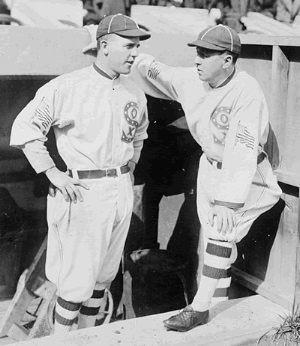
(Photo above: Sox hurler Eddie "Knuckles" Cicotte, left, and manager Pants Rowland, c. 1915-18. From George Grantham Bain Collection, Library of Congress, Prints & Photographs Division. Reproduction No.: LC-USZ62-133664.)

Technorati Tags:

Can’t We All Just Get Along?

By “we,” of course I’m talking about Cubs and White Sox fans. My friend Randy, a former lad of the Chicago suburbs, now a judge in the wilds of western Idaho, called after Game 2 of the World Series last night. At first I thought he was just getting in touch after a very long time to say hi. But he had something else on his mind. As a Sox fan, he wanted to gloat to a Cubs fan about his team’s victory. I disappointed him, I hope, because 1) I’d never root against Chicago (unless the Sox are playing the A’s, my adopted hometown team) and 2) Houston, as the putative hometown of the Bush dynasty, must not prevail.

But even without Houston’s involvement, it’s never been an article of my Cubs faith that I need to hate the Sox; it’s also not part of that faith that I have to like the Cubs, either, though I find myself pulling for them on the rare occasion they play games to care about.

Randy says that he became a convinced Sox fan at age 7, when they went to the World Series. He says he knows all the stats from the team that year, and sleeps with a Sherm Lollar replica athletic supporter under his pillow. Randy’s account made me think about when it was I decided I was a Cubs fan.

Growing up, we rooted for both teams and went to games at both ballparks, and I never heard that my Cubs fan dad had any trepidation walking through the turnstiles at Comiskey Park. I followed the Sox and liked them. They were my mom’s family’s team. They had good-bordering-on-great years in the early and mid-’60s, finishing second in ’63, ’64 and ’65 and going into the last five games of the ’67 season tied for the lead in a close race with Boston, Minnesota, and Detroit. They didn’t manage to win even one despite playing the the last five against the ninth- and tenth-place teams.

The same year, 1967, was the year that the Cubs awoke from a 20-year nap. They’d lost more than 100 games the previous year. They had some mature talent in their lineup (Banks, Williams, and Santo) and had added some good younger players (Kessinger, Beckert, Hundley) along with some decent pitching (Jenkins, Holtzman, Hands and Niekro). Suddenly they were contending. They had an incredible run in June, winning 23 of 27 or something, and went into the All-Star break tied with the Cardinals for first. They faded, but people had started to expect things from them.

I was 13. Impressionable. And maybe I’m a front-runner, too, because after that I was a Cubs fan; 1969, the year of their huge fold and the Mets’ huge run, was just over the horizon; but by then it was too late to back out — I actually cared. And besides, the Sox also-ran dynasty had run its course after ’67, and the folks down at 35th and Shields got a chance to see up close what Cubs fans already instinctively recognized: a loser.

So: Cubs fan, but not overly proud to say it. Hate the Sox? No. To the extent I work up that kind of bile over sports any more, I reserve my bitterness and revulsion for the preciousness surrounding the San Francisco Giants. Used to sort of like them, though.

Come Back, Bill King

One more Bill King story. A friend writes:

My all-time Bill King story was from last summer on a slow day while the team was in Kansas City. (Are there ever any “fast” days there?). The Royals brought out an obscure relief pitcher named Burgos. Bill King’s comment was “Well, he may be the only Burgos in baseball…the only Burgos I recall was Raphael Frübeck de Burgos, a Spanish conductor who used to appear frequently with orchestras around the country.”

Not likely to hear a comment like that from Ken Korach, as much as we like him.