Finn and His People

In honor of the day:

Finn

(from “At Swim-Two-Birds,” by Flann O’Brien)

“… Finn Mac Cool, a hero of old Ireland, came out before me from his shadow, Finn the wide-hammed, the heavy-eyed, Finn that could spend a Lammas morning with girdled girls at far-from-simple chess play. …

“Too great was he for standing. The neck to him was as the bole of a great oak, knotted and seized together with muscle-humps and carbuncles of tangled sinew, the better for good feasting and contending with the bards. The chest to him was wider than the poles of a good chariot, coming now out, now in, and pastured from chin to navel with meadows of black man-hair and meated with layers of fine man-meat the better to hide his bones and fashion the semblance of his twin bubs. The arms to him were like the necks of beasts, ball-swollen with their bunched-up brawnstrings and blood-veins, the better for harping and hunting and contending with the bards. Each thigh to him was to the thickness of a horse’s belly, narrowing to a green-veined calf to the thickness of a foal. Three fifties of fosterlings could engage with handball against the wideness of his backside, which was wide enough to halt the march of warriors through a mountain-pass.”

His People

“… Relate then the attributes that are to Finn’s people. …”

“I will relate, said Finn.

“Till a man has accomplished twelve books of poetry, the same is not taken for want of poetry but is forced away. No man is taken till a black hole is hollowed in the world to the depth of his two oxters and he put into it to gaze from it with his lonely head and nothing to him but his shield and a stick of hazel. Then must nine warriors fly their spears at him, one with the other and together. If he be spear-holed past his shield, or spear-killed, he is not taken for want of shield-skill. No man is taken till he is run by warriors through the woods of Erin with his hair bunched-loose about him for bough-tangle and briar-twitch. Should branches disturb his hair or pull it forth like sheep-wool on a hawthorn, he is not taken but is caught and gashed. Weapon-quivering hand or twig-crackling foot at full run, neither is taken. Neck-high sticks he must pass by vaulting, knee-high sticks by stooping. With the eyelids to him stitched to the fringe of his eye-bags, he must be run by Finn’s people through the bogs and marshes of Erin with two odorous prickle-backed hogs ham-tied and asleep in the seat of his hempen drawers. If he sink beneath a peat-swamp or lose a hog, he is not accepted of Finn’s people. For five days he must sit on the brow of a cold hill with twelve-pointed stag-antlers hidden in his seat, without food or music or chessmen. If he cry out or eat grass-stalks or desist from the constant recital of sweet poetry and melodious Irish, he is not taken but wounded. … One hundred head of cattle he must accommodate with wisdom about his person when walking all Erin, the half about his armpits and the half about his trews, his mouth never halting from the discoursing of sweet poetry. One thousand rams he must sequester about his trunks with no offence to the men or Erin, or he is unknown to Finn. …”

Technorati Tags: ,

On the Hustings

In that little reading list item on the left side of the page — “Daily Kos: 36 Months of Desperately Deadly Delusions” — I found myself using the expression “on the hustings.” Whence does it come?

Brief online researches disclose (for instance, at Word Detective; see the very bottom item of this August 11, 2000 post) that its origins lie in Old Norse (as do those of the House of Brekke, but that’s a longer story). The Oxford English Dictionary has this to say, in an entry that all told runs to more than 1,400 words:

“Old English. hústing, a. Old Norse. hús-thing, house-assembly, a council held by a king, earl, or other leader, and attended by his immediate followers, retainers, etc., in distinction from the ordinary thing or general assembly of the people.”

The OED entry explains that the word evolved over the centuries in English (and England), with meanings including a court of appeals and London’s supreme court; the area in London’s Guildhall inwhich the court was held; the platform in the Guildhall in which London’s mayor and aldermen met; and finally, getting us to the modern political campaign meeting, a platform upon which candidates for Parliament would appear before voters.

Technorati Tags: ,

‘Lend Me Your Ears’

This being the day it is, I started to think about Shakespeare’s “Julius Caesar” and the line, “I come to bury Caesar, not to praise him.” I looked it up to make sure I had it right (I didn’t). I read the scene, which I saw performed once, about 10 years ago, during the late, lamented Berkeley Shakespeare Festival. Unfamiliar with it then, I found it thrilling. And it still is: the purity of the calculation in Antony’s speech, the thoroughness of his triumph as a demagogue, his mastery over the mob.

“Julius Caesar,” Act III, Scene II:

Brutus:

“…Hear me for my cause; and be silent, that you may hear: believe me for mine honour, and have respect to mine honour, that you may believe: censure me in your wisdom, and awake your senses, that you may the better judge. If there be any in this assembly, any dear friend of Cæsar’s, to him I say, that Brutus’ love to Cæsar was no less than his. If then that friend demand why Brutus rose against Cæsar, this is my answer: Not that I loved Cæsar less, but that I loved Rome more. Had you rather Cæsar were living, and die all slaves, than that Cæsar were dead, to live all free men? As Cæsar loved me, I weep for him; as he was fortunate, I rejoice at it; as he was valiant, I honour him; but, as he was ambitious, I slew him. There is tears for his love; joy for his fortune; honour for his valour; and death for his ambition. Who is here so base that would be a bondman? If any, speak; for him have I offended. Who is here so rude that would not be a Roman? If any, speak; for him have I offended. Who is here so vile that will not love his country? If any, speak; for him have I offended. I pause for a reply. … ”

[Enter Antony and others, with Caesar’s body.]

“…Here comes his body, mourned by Mark Antony: who, though he had no hand in his death, shall receive the benefit of his dying, a place in the common wealth; as which of you shall not? With this I depart: that, as I slew my best lover for the good of Rome, I have the same dagger for myself, when it shall please my country to need my death.”

Antony:

“Friends, Romans, countrymen, lend me your ears;

I come to bury Cæsar, not to praise him.

The evil that men do lives after them,

The good is oft interred with their bones;

So let it be with Cæsar. The noble Brutus

Hath told you Cæsar was ambitious;

If it were so, it was a grievous fault,

And grievously hath Cæsar answer’d it.

Here, under leave of Brutus and the rest,—

For Brutus is an honourable man;

So are they all, all honourable men,—

Come I to speak in Cæsar’s funeral.

He was my friend, faithful and just to me:

But Brutus says he was ambitious;

And Brutus is an honourable man.

He hath brought many captives home to Rome,

Whose ransoms did the general coffers fill:

Did this in Cæsar seem ambitious?

When that the poor have cried, Cæsar hath wept;

Ambition should be made of sterner stuff:

Yet Brutus says he was ambitious;

And Brutus is an honourable man.

You all did see that on the Lupercal

I thrice presented him a kingly crown,

Which he did thrice refuse: was this ambition?

Yet Brutus says he was ambitious;

And, sure, he is an honourable man.

I speak not to disprove what Brutus spoke,

But here I am to speak what I do know.

You all did love him once, not without cause:

What cause withholds you then to mourn for him?

“… They that have done this deed are honourable:

What private griefs they have, alas! I know not,

That made them do it; they are wise and honourable,

And will, no doubt, with reasons answer you.

I come not, friends, to steal away your hearts:

I am no orator, as Brutus is;

But, as you know me all, a plain blunt man,

That love my friend; and that they know full well

That gave me public leave to speak of him.

For I have neither wit, nor words, nor worth,

Action, nor utterance, nor the power of speech,

To stir men’s blood: I only speak right on;

I tell you that which you yourselves do know,

Show you sweet Cæsar’s wounds, poor poor dumb mouths,

And bid them speak for me: but were I Brutus,

And Brutus Antony, there were an Antony

Would ruffle up your spirits, and put a tongue

In every wound of Cæsar, that should move

The stones of Rome to rise and mutiny.”

Technorati Tags:

Trivial by Nature

When it comes to any subject, there’s good trivia and bad trivia; or maybe not bad, but ho-hum, something that fits too easily onto a Trivial Pursuit card An example of uninspiring trivia might be: Elvis Presley died on August 16, 1977. An example of good (or at least better) trivia might involve where Elvis was when he was fatally stricken and what was he doing. (For the uninitiated, here’s the scatologist’s-eye view of the King’s passing.)

So I’ve been engaged in some bad and not-so-bad presidential trivia. It’s kind of a way to relax, I guess — or at least put part of my brain on idle (a big part, because I can’t claim any inspirations, related or unrelated, large or small, happened while I focused on this). It started with a simple question, now that Lincoln’s and Washington’s birthdays and Presidents Day have passed: In which month were the most presidents born (posted separately)?

When I start looking at a list of dates, all sorts of facts stick out and relationships suggest themselves. In presidential birth and death dates, perhaps the best-known and most striking is July 4, 1826, the day John Adams and Thomas Jefferson died; a less-mentioned coincidence is that a third president in first five, James Monroe, also died on the 4th of July, in 1831. That kind of coincidence doesn’t show up much in birth dates. Just two presidents — James K. Polk and Warren Harding — share a birthday, November 2 (start planning now).

Ronald Reagan lived longest of all the presidents, 93 years and 120 days. Gerald Ford, born July 14, 1913, could tie the record on Columbus Day this year. Herbert Hoover enjoyed — maybe endured is a better word — the longest retirement, 31 years and seven months. Ford’s in a solid second place in the retirement rankings, but two and a half years behind Hoover; Jimmy Carter, Ford’s successor is No. 4 in the retirement rankings; he’s not gaining on Ford, obviously, but he’ll move into the No. 3 spot, ahead of one-time dual longevity/retirement king John Adams, in early May. (And the shortest retirement? The aforementioned Polk, who outlived his single term by just three months.)

This is the kind of stuff they’re not teaching in our public schools.

After poring over some of the presidents’ biographical data, I did come up with a category that I’m sure someone out in the universe has happened upon but which hasn’t made it into the Wikipedia’s weirdly complete catalog of presidential trivia (see the very end of the entry President of the United States). The little seam I found to mine is represented by our current president and his predecessor: Of all the 42 men who have served as president, the two born closest together are Bush and Clinton. The list:

1. G.W. Bush (7/6/1946)-Clinton (8/19/1946): 44 days.

2. A. Johnson (12/29/1808)-Lincoln (2/12/1809): 45 days.

3. G.H.W. Bush (6/12/1924)-Carter (10/1/1924): 111 days.

4. Jackson (3/15/1767)-J.Q. Adams (7/11/1767): 118 days.

5. Grant (4/27/1822)-Hayes (10/4/1822): 160 days.

6. Nixon (1/9/1913)-Ford (7/14/1913): 186 days.

If you extend the concept to trios, here are the three closest groupings:

1. Wilson (12/28/1856)-Taft (9/15/1857)-T. Roosevelt (10/27/1858): 1 year, 9 months, 29 days.

2. Reagan (2/6/1911)-Nixon (1/9/1913)-Ford (7/14/1913): 2 years, 5 months, 11 days.

3. Arthur (10/5/1830)-Garfield (11/19/1831)-B. Harrison (8/20/1833): 2 years, 10 months, 15 days.

And at the other extreme, the chief executives born furthest apart — considering consecutive presidencies only — are:


1.
Eisenhower (10/14/1890)-Kennedy (5/29/1917): 26 years, 5 months, 15 days.

2. G.H.W. Bush (6/12/1924)-Clinton (8/19/1946): 22 years, 2, months, 7 days.*

3. Buchanan (4/23/1791)-Lincoln (2/12/1809): 17 years, 9 months, 20 days.

4. Jackson (3/15/1767)-Van Buren (12/5/1782): 15 years, 9 months, 20 days.

5. McKinley (1/29/1843)-T. Roosevelt (10/27/1858): 15 years, 8 months, 29 days.

6. Taylor (11/29/1784)-Fillmore (1/7/1800): 15 years, 1 month, 9 days.

7. Reagan (2/6/1911)-Carter (10/1/24): 13 years, 7 months, 25 days.

No conclusions drawn from any of the above. The close birthdays show up some odd coincidences — Lincoln and Johnson, Nixon and Ford and their interrupted presidencies. The presidents born furthest apart might make a more interesting discussion. You might argue that in several cases, at least, the generational differences between the presidents played a role or reflected in some way a larger social and political upheaval that occurred at the same time (best cases for that: Buchanan-Lincoln, Kennedy-Eisenhower, McKinley-Roosevelt; worst case: Taylor-Fillmore).

That’s it. My brain’s very relaxed now.

*Added 3/5/2006 based on reader email that pointed out the difference in the first Bush’s and Clinton’s ages.

Polk-Harding Day: Early Warning

As explained elsewhere, I was noodling with White House birthdays. For your party-planning purpses — let’s get ready for Polk-Harding Day ’06! — here’s a calendar of sorts of the birthdays of the presidents:

January February March
Fillmore (7)
Nixon (9)
McKinley (29)
F.D. Roosevelt (30)
Reagan (6)
W.H. Harrison (9)
Lincoln (12)
Washington (22)
Jackson (15)
Madison (16)
Cleveland (18)
Tyler (29)
April May June
Jefferson (13)
Buchanan (23)
Grant (27)
Monroe (28)
Truman (8)
Kennedy (29)
G.H.W. Bush (12)
July August September
Coolidge (4)
G.W. Bush (6)
J. Q. Adams (11)
Ford (14)
Hoover (10)
Clinton (19)
B. Harrison (20)
L. B. Johnson (27)
Taft (15)
October November December
Carter (1)
Hayes (4)
Arthur (5)
Eisenhower (14)
T. Roosevelt (27)
J. Adams (30)
Polk (2)
Harding (2)
Garfield (19)
Pierce (23)
Taylor (24)
Van Buren (5)
Wilson (28)
A. Johnson (29)

Equal Time

It wouldn’t be Presidents Day without “Equal Time.” But before I get to that, a piece of melancholy: We have a paperback on our shelf — actually we have books on more than one shelf, and I mean to say this book is on a shelf — called “Love Trouble.” The author is Veronica Geng, and she’s pictured on the cover. In pajamas, girlish, smiling in a way that looks like she’s ready to share some mischief. The book, which came out in 1999, was published posthumously; Ms. Geng, an editor and writer for The New Yorker, had died of a brain tumor a couple years earlier. No more mischievous fun except in the writing she left behind.

When Ronald Reagan was still president, and we all know how long ago that was, The New Yorker ran a very, very short piece — no more than six column inches I’d guess — called “Equal Time.” It was Ms. Geng’s work, but I didn’t make anything of that. What Kate and I loved about it was the off-the-wall take on — well, you’ll see. The piece was clipped and stuck on a series of refrigerators. It was copied and sent to friends. Kate just came across the little blow up she made of it nearly 20 years ago.

Equal Time

“You know recently one of our most distinguished Americans, Clare Boothe Luce, had this to say about the coming vote [on aid to the Contras]. “… My mind goes back to a similar moment in our history–back to the first years after Cuba had falledn to Fidel. One day during those years, I had lunch at the White House with a man I had known since he was a boy–John F. Kennedy. ‘Mr. President,’ I said, ‘no matter how exalted or great a man may be, history will have time to give him no more than one sentence. George Washington–he founded our country. Abraham Lincoln–he freed the slaves and preserved the union.’ “–Ronald Reagan, address to the nation March 16, 1986.

William Henry Harrison: He was the first occupant of the White House to eat with a knife and fork.

Millard Fillmore: He had his own likeness secretly engraved in the folds of Miss Liberty’s dress on the 1851 Silver Dollar.

Franklin Pierce: He earned the sobriquets Old Tongue-in-Groove and The Gabardine Gangplank.

Ulysses S. Grant: He translated the words to “The Star-Spangled Banner” into thirteen different languages, including mirror writing.

Benjamin Harrison: He predicted the birth of the Dionne Quintuplets over forty years before it happened.

William McKinley: He was his own grandfather.

Warren G. Harding: He campaigned on a bicycle carved from a single giant bar of soap.

Calvin Coolidge: He coined the catchphrase of the era–“Do you simply want a cigarette, or do you want a Murad?”

Herbert Hoover: He reorganized the National Christmas Card Cemetery.

Gerald Ford: He had the idea for “Shampoo” long before the movie came out.

Ronald Reagan: He popularized the political theories of Clare Boothe Luce.

[Copyright 1999, The Estate of Veronica Geng]

Lincoln Again

I should probably wait until I finish the Lincoln book I’m in the middle of now — “Team of Rivals” — before embarking on another one. But The New York Times Book Review today writes up a volume by British historian Richard Carwardine, “Lincoln: A Life of Purpose and Power.” The review, by novelist Kevin Baker, is worth a read (it’s available on the Times site for a week):

“In dissecting Lincoln’s triumph, Carwardine has provided us with a democratic version of Machiavelli’s ‘Prince,’ a primer on how power can and should be won and used in a free society. Lincoln, he shows us, expertly employed both the machinery of his new party and the authority of his office. He preferred peaceful and lawful means to his ends, but he did not hesitate to press constitutional bounds to the breaking point — for instance, suspending habeas corpus, shutting down the occasional newspaper and detaining thousands of Southern sympathizers — in the desperate struggle to keep the nation together.”

Dead Veeps Club

You know, looking at the histories of Dick “Gunner” Cheney and Aaron “Unfriendly Fire” Burr — brothers in the fraternity of vice presidents whose hunts have netted human trophies — disclosed yet another fact that until now escaped me: the number of U.S. vice presidents who have died in office. Here’s a brief list. Take note: November is the cruelest month for our unrevered second bananas, having claimed four of the seven executive understudies who died in office.

George Clinton (1739-1812): Served as vice president in Thomas Jefferson’s second term and was re-elected to the office for James Madison’s first term. Died April 20, 1812, the first vice president to expire in office.

Elbridge Gerry (1744-1814): Clinton’s office sat vacant, and Gerry — the Massachusetts pol whose skill at drawing imaginative legislative boundaries is memorialized in the word “gerrymander” — was elected for Madison’s second term. But serving as No. 2 for Madison proved too much for Gerry, too. He died November 23, 1814, having served just 20 months.

Daniel Tompkins (1774-1825; honorable mention): Just missed becoming the third consecutive veep to die in the traces. He served two terms as James Monroe’s vice president, leaving office in March 1825. He died three months later at age 50 after what one biography describes as “a decade of financial privation and heavy drinking, coupled with accusations that he had mishandled state and federal funds while serving as governor of New York. …”

William Rufus de Vane King (1786-1853): Served just six weeks as understudy to Franklin Pierce in March and April 1853. Actually, “served” might be padding King’s resume a bit. He suffered from tuberculosis when he was elected and was in declining health as his inauguration approached. He repaired to Cuba for his health and was granted permission to be sworn in there (reportedly the only vice president inaugurated outside the United States). With his condition apparently terminal, he returned home to his Alabama plantation, where he died April 18.

Henry Wilson (1812-1875): Grant’s second vice president. Died midway through his term on November 22, 1875. A former Senator from Massachusetts, he was eulogized thus by a former colleague: “He was not learned, he was not eloquent, he was not logical in a high sense, he was not always consistent in his political actions, and yet he gained the confidence of the people, and he retained it to the end of his life.” Except for the “confidence of the people” part, that sounds very familiar.

Thomas A. Hendricks (1819-1885): Elected vice president with Grover Cleveland as part of the first Democratic ticket to win since 1856. Hendricks died November 25, 1885, a little more than eight months into his term.

Garret A. Hobart (1844-1899): Elected with McKinley in 1896. I’m guessing that he and McKinley are probably the only running mates to both die in office — though McKinley wasn’t assassinated until early in his second term, when he had a brand spanking new vice president in place. Hobart, described in a Senate biography as a “rotund, jovial, hospitable man,” was beset by heart problems that finally killed him on November 21, 1899. Before passing into eventual blog fodder, however, Hobart cast the deciding vote against a resolution that would have promised independence to the Philippines. He made a difference.

James Sherman (1855-1912): Taft’s vice president, he came darn close to serving a full term before dying on October 30, 1912, of chronic kidney failure. He died just days before the presidential election (Taft vs. Wilson and Roosevelt, T.), thus became the only deceased candidate for national office to stand for election (that’s an unverified claim).

A Lifetime of Lincoln

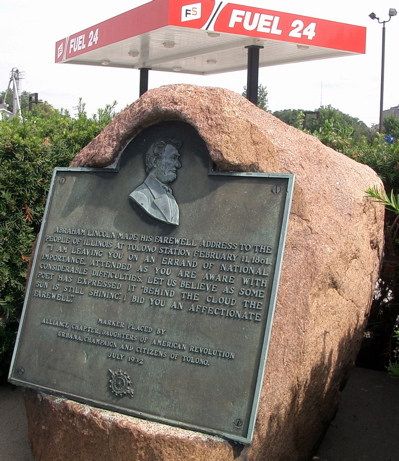
Lincolntolono1

(Lincoln marker in Tolono, Illinois; September 2004)


Growing up in the adopted land of Lincoln, and growing up in the ’60s, when Civil War echoes were loud, reminders of the 16th president were everywhere — license plates, highway and street names, and parks. Oh, yeah: And log-cabin-type toys. So on his birthday, I’m thinking of all the places I’ve run into Lincoln.

1954

I’m born 145 years after Lincoln. The Lincoln connection: This is the year Illinois began printing “Land of Lincoln” on its license plates.

1960.1

During two weeks when I was out of school with first the chicken pox, then the mumps, my dad gets me a Fletcher Pratt history of the Civil War. Words like “Potomac” enter my vocabulary (pronounced “POT-o-mac”).

1960.2

Mom and Dad bundled the three of us kids (me and sibling costars John and Chris; my sister Ann joined the cast in ’62) into our red-and-white Ford stationwagon early one Saturday evening for a sudden road trip. I think it was a Saturday, anyway. That night, we wound up in a motel in Jeffersonville, Indiana, just across the Ohio River from Louisville, where Mom’s brother Tom was serving as a Carmelite priest. We spent the next day doing north-central Kentucky sight-seeing. The two stops I remember: The Cistercian monastery at Gethsemane and Lincoln’s birthplace near Elizabethtown. The cabin in which he was said to have been born — and later, I came to the disappointing realization that the cabin is a reconstruction — was tiny and dark.

c. 1960-62.

I see Carl Sandburg’s multivolume biography, “Lincoln, the Prairie Years and the War Years,” on my parents’ bookshelf. I don’t think I ever cracked it. On the other hand, I did open “The Day Lincoln Was Shot,” by Jim Bishop. My mom liked to tell the story of how I came to her after reading the book. She said that I was crying and told her, “They killed him.” I’d love to be able to say I remember all this like it was yesterday, but I don’t recall it.

c. 1962-63

Another semi-literary encounter with Lincoln: Another book that wound up in my hands thanks to my parents was a sort of abridged kid’s editions of notable American Heritage magazine articles. The book’s long lost now, but it seems like I spent years poring over it. It had stories about a colonial siege of a French fort, the naval exploits of Oliver Hazard Perry and James Lawrence (the latter credited with coining the phrase “don’t give up the ship), a star-crossed early Navy ship called the USS Constellation, the country’s first oil boom (Titusville, Pennsylvania), and the art of Gilded Age valentines. The book also had a piece on how when the Lincoln Memorial opened, the lighting on the statue of Lincoln was all wrong and had to be fixed (an unabridged, pictureless version of the article is online: “Light for Lincoln’s Statue“).

1970

Lincolnian Nixon: In the midst of the antiwar upheaval, right after Nixon had sent U.S. forces into Cambodia and four students had been killed by National Guard troops at Kent State University in Ohio, a big march was called in Washington. Very early the morning of the demonstration, Nixon went out to the Lincoln Memorial, where many protesters had already gathered. Getting out among the people — it was a positively Lincolnian gesture when viewed from an era in which the president systematically excludes critics from his audiences. (A second Nixon/Lincoln Memorial memory: Ask me and maybe I’ll tell you about the time I dreamed I assassinated Nixon on the steps of the memorial. Really.)

1971

My dad and my brother Chris and I drove out to Gettysburg (John was sick with pneumonia and I guess Ann didn’t come because it was a guy trip or something. I’m sure she’ll set me straight). History will little note nor long remember my visit, unlike Lincoln’s in 1863.

1973

On a whim, I hitchhiked to Washington to see the Watergate hearings. It was tough getting rides and I wound up taking a long detour to Watkins Glen, New York, where The Band, Allman Brothers and Grateful Dead were playing a one-day concert at the racetrack there. I eventually made it to Washington, but without enough money to get a motel room anywhere. I wound up at the Lincoln Memorial after dark — the first time I’d ever been there. I was so tired from the trip that I sat down, leaning against one of the columns outside, and fell asleep. It was a very warm night, and eventually I stirred myself, strolled out toward the Washington Monument, found a spot that seemed inconspicuous, and went to sleep. I got into the hearings the next day. Richard Helms, the former director of the CIA, was testifying. Dick Cavett was in the audience, wearing a blue workshirt and a kerchief around his neck.

1988

During a family visit to New Jersey, my brother John and I rented a car and with my older son Eamon (who was going on 9) took the Garden State Parkway down to Cape May, where we got on the ferry to Lewes, Delaware. We decided to drive into Washington along U.S. 50, from the east. The day had been blistering, and it didn’t cool down much after dark. We got a room at the first motel we saw, the Day’s Inn on New York Avenue, as I recall, and then went out to explore a little. We made it to Georgetown, called our Illinois friends the McCrohons about 10 o’clock, and went over to their place, on Connecticut a few blocks above DuPont Circle. We got to talking, the natural state of affairs, and didn’t leave until about 2. Eamon was asleep in the back seat, so John and I decided we should do a little more landmark reconnoitering. We wound up down at the Lincoln Memorial around 3. I’m having a hard time believing I did this — maybe we took turns getting out of the car or something, or maybe I trusted that since we were parked nearby it would be OK to leave Eamon in the car — but we spent half an hour or so at the Vietnam Memorial. We spent the next day in Washington with the McCrohons. The following day, we returned to New Jersey by way of a sweeping detour to Harper’s Ferry, West Virginia, and the Antietam battlefield. Antietam: Lincoln went there, too, to try to prod his commanding general into action (he wound up having to fire him).

2004

I went back to Illinois in September 2004 to take a driving trip with my dad. We weighed a couple long road trips — out to western Kansas on two lane roads, for instance — and settled on a trip down to the southern tip of Illinois. Headed down Interstate 57, we rolled through Champaign and then saw a sign for Tolono, a place I wanted to see because an old Utah Phillips railroad song carries the name of the town. Our first improbable sighting after deparing the interstate: an inline skater in the oncoming lane, wearing shorts and a backpack but no shirt. The second was in town: A historical marker commemorating Lincoln’s stop at the railroad junction there on February 11, 1861, as he headed east for his inauguration. The marker, on the grounds of a gas station, reported that Lincoln made his last speech in Illinois in Tolono (reporters on the train with him said he made “remarks” in Danville, a little further east, as well as at the Indiana-Illinois border). Dad and I drove on south to Cairo and a little beyond, then doubled back north along the Mississippi, crossing the river several times on car ferries. On the way back to Chicago after stopping to see Mother Jones’s grave in Mount Olive, we got off the highway in Springfield to see the important public buildings there. Then we found our way to the cemetery in a pleasant, leafy neighborhood north of downtown where Lincoln is buried. The tomb is heroic in scale and much more martial than I expected with statues of Union soldiers in a variety of vigllant, fighting poses. We left as the sun started to set and drove back to Chicago in the dark.
‘Citizen King’

After that football game, of which for reasons disclosed elsewhere I saw only the last quarter, Kate came home and our ensuing channel surfing fetched up on “Citizen King,” an episode of “The American Experience” on Martin Luther King, Jr. Probably because you know the way the story is going to come out, or at least his part of it, it has the feeling of a tragedy alongside which the made-up kind pale (sorry, Will). The tragedy resounds the more deeply because of the aftermath of King’s death. One can hardly argue that we’ve reached that moment he talked about the night before he died that his people — the black, the poor, and the oppressed, would reach the promised land. It wasn’t a promised land just for those whose cause he made his own; it was a destination for the United States, too. I wonder, with the pictures of the mid-60s, and 1968 especially, fresh again, whether the nation suffered a blow, a spiritual injury, that was too big to be overcome in our lifetimes. That may be the still-impressionable spectator of the events talking; the sizable portion of the population born since then might ask what’s the big deal. But it’s true, too, that as a nation we’re swept along by the silent currents of events that predate us, predate our families’ arrival in the United States.

And speaking of family connections, there was a moment in the film when my Uncle Bill appeared on the screen. He spent a lot of time in his career as a Catholic priest in Chicago working on movement issues, and joined some of King’s campaigns in the South (the Selma-Montgomery march in 1965, for instance; amazingly, the route of the march is now a National Park Service National Historic Trail). Anyway, Bill: The documentary included an extensive section on King’s campaign in Chicago, including his marches in Cicero and the segregated neighborhoods of Gage Park and Marquette Park. Suddenly, there was film of marchers filing down the sidewalk, and for two seconds, maybe, there’s Bill. I went back and looked again (on Tivo — well, there’s one thing about the world you can say is better than the ’60s). No doubt — it was him, caught just for an instant doing what he did.